
Palestine Crisis Map
Sept 17, 2015: Israel OK's sniper fire against stones. 2015-2020: ~100,000 more Israeli settlers move to West Bank & Jerusalem. Jan 2022-Sept 2023: ~404 Palestinians, 58 Israelis killed. 10/7/23 to date: ~73,700+ Palestinians, ~1,850 Israelis killedVerified
In first, Israel convicts Palestinian citizens for chanting slogans
12:00 Apr 29 2026 Haifa (חיפה حيفا )
Description
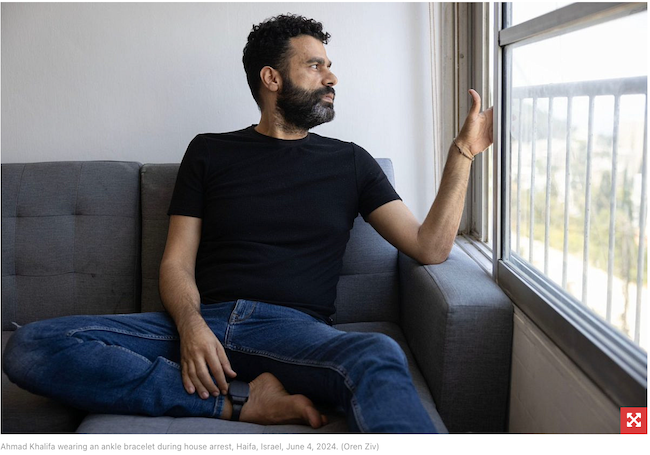
Photo:Ahmad Khalifa wearing an ankle bracelet during house arrest, Haifa, Israel, June 4, 2024. (Oren Ziv)
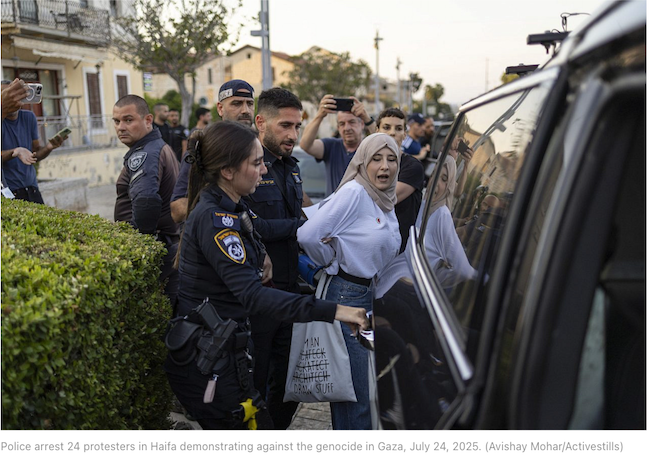
Police arrest 24 protesters in Haifa demonstrating against the genocide in Gaza, July 24, 2025. (Avishay Mohar/Activestills)
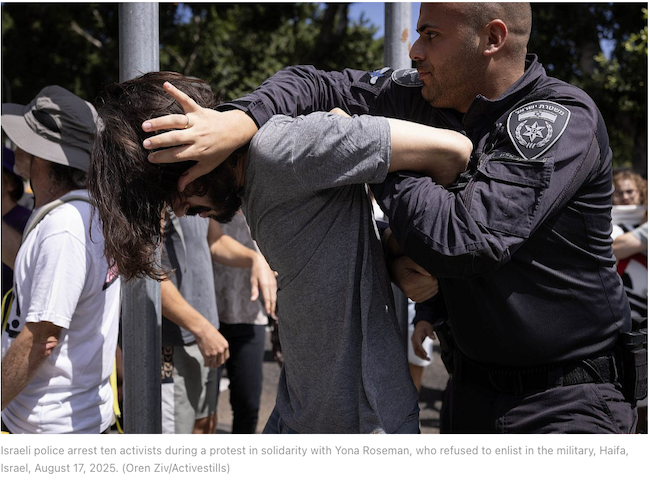
Israeli police arrest ten activists during a protest in solidarity with Yona Roseman, who refused to enlist in the military, Haifa, Israel, August 17, 2025. (Oren Ziv/Activestills)
____
A Haifa court found two men guilty of ‘indirect incitement to terrorism’ after they joined an anti-war protest. Lawyers warn it sets a dangerous precedent.
by Baker Zoubi for 972Mag
May 20, 2026
Over the past two and a half years, Palestinian citizens of Israel have seen their political and civic rights — already limited before October 7 — dramatically constricted. They have been arrested for social media posts, publicly humiliated by state officials, persecuted in their workplaces and universities for expressing political opinions, and held without charge in administrative detention. Long subjected to discrimination under Israeli law, Palestinians citizens witnessed the state take advantage of the Gaza war to pass 30 new bills entrenching apartheid and Jewish supremacy.
Now, a new threshold has been crossed: For the first time, Palestinians inside Israel have been criminally convicted for chanting political slogans at a protest.
On April 29, the Haifa Magistrate’s Court convicted 31-year-old activist Mohammad Taher Jabareen and 42-year-old attorney Ahmad Khalifa of “indirect incitement to terrorism” and “identification with a terrorist organization,” charges that carry a combined maximum sentence of eight years in prison. The decision came after more than 30 months of legal proceedings — during which Khalifa and Jabareen were held in administrative detention for four and eight months, respectively, before being released to house arrest.
The conviction was based on political chants heard during an anti-war protest the two participated in on Oct. 19, 2023 in Umm Al-Fahm, one of the largest Palestinian cities in Israel. These were traditional slogans that have been used for decades at demonstrations and public events across Israel, and included no direct calls for violence: from “With soul and blood, we redeem you, Oh Gaza!” to “There is no solution except uprooting the occupier” and “Gaza shall not submit to the tank or cannon.”
During the hearings, both the police and the state acknowledged that the slogans themselves contained no reference to Hamas or other banned organizations, an offense which is indeed illegal under Section 24 of Israel’s Counter-Terrorism Law. Nevertheless, the court adopted the prosecution’s interpretation of the slogans’ meaning, without specifying in its ruling which “terrorist organization” the alleged offense of “identification” supposedly referred to.
The court also ignored the immediate context of the protest, which was a response to the deadly explosion at the Al-Ahli Hospital in Gaza City 12 days after the outbreak of the war. Instead, it ruled that chanting the slogans in “the circumstances and timing close to October 7” was sufficient to constitute indirect incitement.
“What we did was natural and legitimate,” Jabareen told +972 Magazine, in response to the court’s decision. “We demonstrated to demand an end to the war against innocent civilians in Gaza, out of both a human and national duty, and out of our natural right to express an opinion and protest.”
For Mohammad Zeidan, a human rights activist and former director-general of the Arab Association for Human Rights, the ruling raises profound questions about the future of freedom of expression for Palestinian citizens. Criminalizing Palestinian slogans as indirect incitement, he told +972, “opens the door to new legal precedents, whereby in the future any slogan chanted at a protest could be treated as an offense warranting punishment, based on interpretations that may rely more on presumed intentions than on facts.”
‘A political court in every sense’
Jabareen and Khalifa were represented by lawyers from the Haifa-based legal center Adalah — including Dr. Hassan Jabareen and Hadeel Abu Saleh — as well as attorney Afnan Khalifa. During the trial, they argued that the same slogans had been chanted at other demonstrations both before and after October 7, without any legal action being taken against those who used them.
The defense also pointed out that additional participants at the same protest had chanted the same slogans but were not prosecuted. Although the court acknowledged that the police had failed by not investigating additional participants, it ruled that this failure did not undermine the validity of the indictment against Jabareen and Khalifa.
“We are facing a political court in every sense, whose goal is to persecute the political activity of Palestinian citizens of Israel,” Abu Saleh said after the ruling. “From the very first day, it was clear that the trial would rely on broad interpretations detached from the context of the demonstration, in a way that violates the principle of justice — and that is exactly what was reflected in the court’s decision.
“This decision is a continuation of the policy of persecuting Palestinians in Israel since October 7,” Abu Saleh continued. “It is clear that this case is meant as a message of intimidation directed at the public, and we will confront it through every legal means available to us.”
The case sparked broad discussion regarding the background of Ihsan Halabi, the judge who signed the ruling and headed the panel that issued the verdict. Halabi served for 22 years in various judicial positions within the military court system before transferring to the civilian judiciary only four years ago. After the conviction, activists objected to the fact that a judge with such an extensive military background would preside over cases concerning freedom of expression and civic activity, especially in cases related to the rights of Palestinian citizens of Israel.
Zeidan also placed responsibility for Palestinian citizens’ dwindling freedoms on the Arab political parties, which he sees as having overrelied on parliamentary-based activism. “When the Knesset turns from being one tool among many in the struggle into its sole central objective, a huge vacuum is created in the street,” he said. “This contributed to the decline of popular protest and made it easier for the establishment to isolate individuals who chose to protest spontaneously.”
But in the context of a broader state-led effort to redraw the boundaries of Palestinian political activity in Israel, there is only so much the Arab parties can do. “The conviction was not entirely surprising, because there is a general atmosphere seeking to narrow the space for freedom of expression,” Zeidan said. “How many theaters have been shut down? How many artists have been persecuted?
“A ruling like this can be understood as a deterrent message to others, not merely punishment of the defendants — especially because it targets prominent and influential activists who demonstrated leadership during the war.”
A version of this article was first published in Hebrew on Local Call. Read it here.
Baker Zoubi is a journalist and Palestinian citizen of Israel, based in the village of Kufr Maser in the Lower Galilee. He began his career in 2010 as a reporter for local Arab media outlets, before advancing to the position of senior editor at the Nazareth-based news platform Bokra. Since 2021, he has been a contributing writer at Local Call and +972 Magazine, while continuing his work as a part-time news editor at Bokra and publishing op-eds on political and social issues in Palestinian society. h. In addition to his journalistic work, he collaborates with several institutions on translation and text editing projects and occasionally edits television programs. He and his wife Yara have three children: one daughter, Jida, and two sons, Jabr and Jawad.
News Source Link
https://www.972mag.com/israel-convicts-palestinians-protest-slogans/https://www.mekomit.co.il/%d7%94%d7%97%d7%a8%d7%a4%d7%94-%d7%91%d7%a8%d7%93%d7%99%d7%a4%d7%aa-%d7%94%d7%90%d7%96%d7%a8%d7%97%d7%99%d7%9d-%d7%94%d7%a2%d7%a8%d7%91%d7%99%d7%9d-%d7%94%d7%a8%d7%a9%d7%a2%d7%94-%d7%91%d7%92%d7%99/
https://en.wikipedia.org/wiki/Haifa
| Credibility: |  |
 |
0 |
Additional Reports
Clashes in Haifa over Gaza operation, 30 arrested. MK Zoabi detained and released.
12:00 Jul 18, 2014
Haifa, 0.96 Kms
Palestinian Seriously Injured After Being Stabbed In Haifa
12:00 Jul 22, 2022
Haifa (חֵיפָה * حيفا), 1.18 Kms
Israeli court extends detention without trial for Palestinian citizen of Israel
12:00 Aug 27, 2017
Haifa, 1.21 Kms


Leave a Comment