
Palestine Crisis Map
Sept 17, 2015: Israel OK's sniper fire against stones. 2015-2020: ~100,000 more Israeli settlers move to West Bank & Jerusalem. Jan 2022-Sept 2023: ~404 Palestinians, 58 Israelis killed. 10/7/23 to date: ~73,700+ Palestinians, ~1,850 Israelis killedVerified
Limited Movement Through Rafah as Patients and Returnees Cross
12:00 Feb 8 2026 Rafah border crossing (معبر رفح)
Description
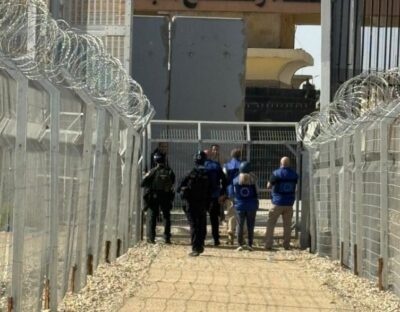
Photo:Rafa crossing. Published by IMEMC News
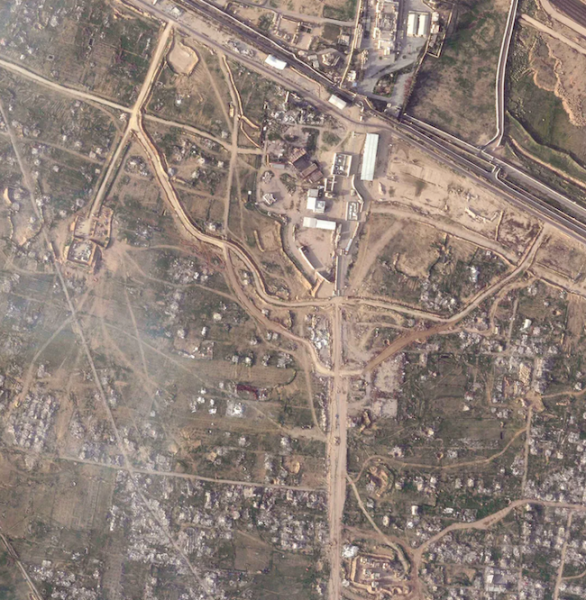
Rafa crossing Feb 4-11, 2026. Published by Haaretz
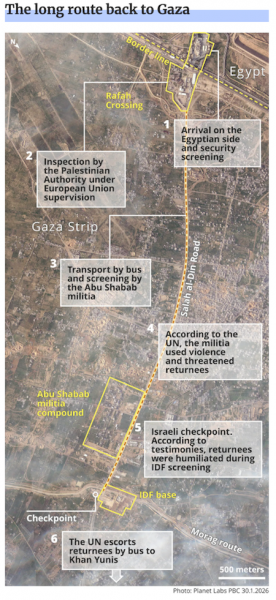
Long Route Back to Gaza, Graphic Published by Haaretz
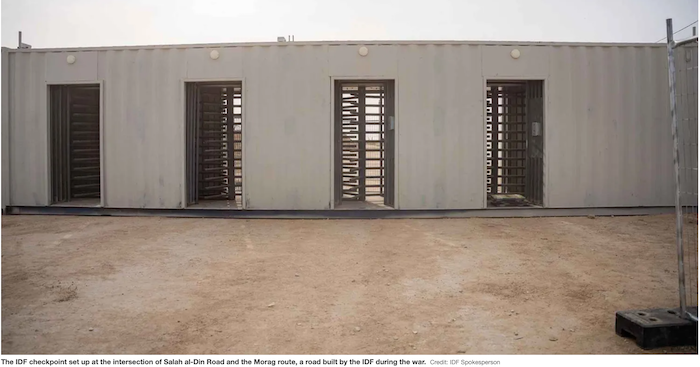
The IDF checkpoint set up at the intersection of Salah al-Din Road and the Morag route, a road built by the IDF during the war. Credit: IDF Spokesperson. Published by Haaretz
See additional video at IMEMC News Source Link
______
by IMEMC News
Feb 9, 2026
The Rafah Crossing with Egypt saw only limited movement on Sunday as a small group of Palestinians who had completed medical treatment in Egypt were cleared to return to Gaza, while another group of patients from inside the Strip was transported toward the terminal for evacuation.
Although the crossing was formally reopened earlier this month, travel remains tightly restricted, with only a few dozen people allowed through each day.
The Palestinian Red Crescent Society (PRCS) said 44 Palestinians left Gaza on Sunday, among them 19 patients and 27 accompanying relatives.
According to the Government Media Office, 135 Palestinians exited the Strip between February 2 and 5, bringing the total number of departures since the partial reopening to 179.
_____
Militias, Interrogations and Threats: The Harrowing Road Back to Gaza
by Yarden Michaeli, Rawan Suleiman, and Nir Hasson for Haaretz
Feb 11, 2026
After a prolonged closure, the Rafah Crossing reopened last week to limited traffic in and out of the Gaza Strip, in line with the implementation of Phase 2 of the cease-fire declared by U.S. President Donald Trump. As of Sunday, 284 people had passed through the crossing – half leaving for Egypt and half entering Gaza – according to the European supervisory team stationed there.
Now, after a week of operations, eyewitness accounts by Gazans, videos and satellite images can be combined to show how the mechanisms for entering the Gaza Strip operate. At least six parties are involved – Egypt, the Palestinian Authority, the European Union, the Abu Shabab militia operating under Israeli auspices, the Israel Defense Forces and the United Nations.
Over a route of roughly 15 kilometers, Gazans returning home undergo a series of inspections. The journey begins at the Rafah Crossing and ends at Nasser Hospital in Khan Yunis. Although the route could theoretically be completed quickly, in practice it is an exhausting ordeal that can take an entire day, and sometimes longer. Returnees describe being interrogated, threatened and humiliated, as well as facing strict limits on how much money and belongings they are allowed to bring with them.
Palestinians who have returned to Gaza testified in the media that they were instructed by the Palestinian embassy in Cairo to arrive at night in the Egyptian coastal city of El-Arish, near Rafah. From there, they travel to the Rafah Crossing for a lengthy security screening before being admitted into Gaza.
"We packed our bags at 2 A.M. on Monday, the bus left for the crossing at 3, and we reached the Egyptian terminal at 6," said Sabah al-Raqab, 41, in an interview with the newspaper Felesteen. "They checked us, and then we had to wait until sunset for the Palestinian side to open to stamp our passports."
After completing the Egyptian inspection and crossing the border, returnees pass through a checkpoint on the Gaza side of the crossing. In preparation for the reopening, metal fences topped with barbed wire were installed to separate entry and exit routes. The Gaza side of the crossing is operated by Palestinian Authority personnel under the supervision of a European Union team known as EUBAM Rafah – the European Union Border Assistance Mission for the Rafah Crossing Point. There is no IDF presence in this area.
Among other procedures, those passing through undergo facial recognition checks. Returnees are permitted to bring one bag containing clothing and documents, one mobile phone, and up to 2,000 shekels (about $650). Liquids are prohibited.
After completing this inspection, Gazans leaving the facility are at the Israeli-controlled portion of the Strip. They are transported by bus along Salah al-Din Road to an IDF inspection point located about five kilometers away.
But, before reaching the IDF checkpoint, they pass inspection by militants from Abu Shabab, a local Palestinian militia backed by Israel. Cooperation between the IDF and the militia has previously drawn sharp criticism, including from IDF commanders. Last week, a defense source confirmed to Haaretz that militiamen have been accompanying Gazans entering the Strip.
According to eyewitnesses and video documentation, the militiamen escort returnees to an IDF checkpoint set up at the intersection of Salah al-Din Road and the Morag route, a road built by the IDF during the war. The UN Office for Human Rights has collected evidence indicating that militiamen have handcuffed some returnees, blindfolded them and threatened them. Additionally, according to some testimonies, the militiamen searched luggage and stole personal belongings and money.
Issan al-Dahini, the leader of the Abu Shabab militia in Gaza, published a statement calling on returnees to join his ranks in Israeli-controlled territory: "To anyone returning to Gaza, among those who oppose terrorism and wish to join us and live in Rafah, please report to the Popular Forces checkpoint in the area of the Rafah crossing."
The militiamen then hand the returnees over to the IDF at a checkpoint recently established on the main road, known by the army as Nekaz Regavim. A relatively large military base has been located at this site for some time. Passage through the IDF checkpoint can take several hours, according to accounts from Gazans published in Arab media outlets.
"I was very frightened. For three hours, we were in the screening area," said Ismat Saafi, 48, in an interview with al-Araby al-Jadeed. "I couldn't walk or even move because I suffer from high blood pressure and heart problems."
"They left me with my daughter and grandchildren in an area surrounded by cameras and concertina wire fencing," she said. "Eventually, they called me and asked my name, about my grandchildren and where I lived. I heard another woman crying in the interrogation room next door. We had an elderly man with us. They handcuffed him, covered his eyes and interrogated him harshly."
These testimonies align with accounts collected by the UN regarding the IDF checkpoint and published on February 5. According to the report, "returnees described a pattern of violence, degrading interrogations, and invasive body searches, in some cases while blindfolded and handcuffed. They also reported that soldiers denied them access to medical care when needed, and access to bathrooms, resulting in extreme humiliation, including being forced to urinate in public."
The UN also reported that "several returnees said they were asked whether they would accept money to return to Egypt with their families and never return. Some said that they were offered money to become informants for the Israeli military."
After completing the IDF screening, returnees continue by bus, this time escorted by staff from the United Nations Development Program. The bus crosses the Yellow Line separating Israeli- and Hamas-controlled areas of Gaza and proceeds to Nasser Hospital in Khan Yunis. Upon disembarking, several Gazan women called out to the crowd, "Don't leave, don't emigrate from Gaza."
In addition to those returning to the Strip, large numbers of Gazans are attempting to leave in order to receive medical treatment. According to the World Health Organization, about 18,500 people – including 4,000 children – are waiting to exit Gaza. In the week since the Rafah Crossing reopened, fewer than 150 people have actually left – the same number as those who have entered.
On Sunday, the Israeli NGOs Gisha and Adalah – The Legal Center for Arab Minority Rights appealed to Defense Minister Yisrael Katz, the chief military advocate and the attorney general, urging them to order the IDF to halt what they described as harassment of Gazans seeking to return to the Strip. In their appeal, attorneys Mohamed Awad and Muna Haddad argued that the abuse is intended to deter Palestinians from returning.
"It appears that the returning residents were taken against their will, and at risk to their lives and safety, by armed militias operating in coordination with the Israeli army, and subjected to lengthy security interrogations as a condition for passage," they wrote. "Testimonies and the military's conduct indicate that these actions were intended not only to humiliate and harm residents returning to their homes, but also to terrorize and sow fear among those wishing to return to the Strip."
They argued that such conduct violates Israel's obligations under international law. The Universal Declaration of Human Rights states that "everyone has the right to leave any country, including his own, and to return to his country." This right is also enshrined in treaties to which Israel is a signatory, including the Covenant on Civil and Political Rights, the Geneva Convention, the Convention against the Crime of Apartheid and the Rome Statute.
"Thousands are living with the hope of returning," a Gazan who managed to make it back to the Strip told the Palestinian news agency Wafa. "There are tragic stories here – families torn apart, husbands and wives each in a different place, fathers who have not seen the children born to them. Open the crossing for real; in practice, the crossing has still not opened."
After publication of the article, the IDF responded to Haaretz's inquiries: "Contrary to the claims, during inspections at the Israeli screening point for Gazans entering the Gaza Strip from Egypt, no incidents of improper conduct or abuse by Israel's security system are known. Security forces at Nekaz Regavim verify the identities of those entering against lists approved by the Ministry of Defense and conduct thorough inspections of luggage. It should be emphasized that the baggage entry policy at the Rafah Crossing and the various security procedures were conveyed and published in advance to all relevant parties."
The IDF did not address Palestinian testimonies regarding the use of the Abu Shabab militia as part of the mechanism for returning to the Strip.
News Source Link
https://imemc.org/article/limited-movement-through-rafah-as-patients-and-returnees-cross/https://www.haaretz.com/israel-news/security-aviation/2026-02-11/ty-article-magazine/.premium/rafah-crossing-militias-interrogations-and-threats-the-harrowing-road-back-to-gaza/0000019c-479d-d571-affe-5fd
https://en.wikipedia.org/wiki/Rafah_Border_Crossing
| Credibility: |  |
 |
0 |
Additional Reports
Rafah Border Completely Sealed Since Israeli Military Takeover 3 Days Ago
12:00 May 10, 2024
Rafa border crossing (معبر رفح), 0.08 Kms
Rafah crossing reopens allowing passage in both directions
12:00 Aug 19, 2018
Rafah crossing, 0.09 Kms
UN Halts Food Distribution in Rafah Due to Supply Shortages and Insecurity From Israeli Strikes
12:00 May 21, 2024
Rafa border crossing (معبر رفح), 0.12 Kms


Leave a Comment