
Palestine Crisis Map
Sept 17, 2015: Israel OK's sniper fire against stones. 2015-2020: ~100,000 more Israeli settlers move to West Bank & Jerusalem. Jan 2022-Sept 2023: ~404 Palestinians, 58 Israelis killed. 10/7/23 to date: ~75,500+ Palestinians, ~1,850 Israelis killedVerified
Colonizers Continue Attacks Across the Occupied West Bank
12:00 Nov 22 2026 Deir as-Sudan (دير السودان), Kafr Malik (كفر مالك), Burqa, Birin al-Mughayyir, Deir Dibwan, Yatta, Hallet al-Hummus, Adorayim outpost, Wadi ash-Shunnar, Hebron City, Ras al-Ahmar, Beita, & Yasuf
Description
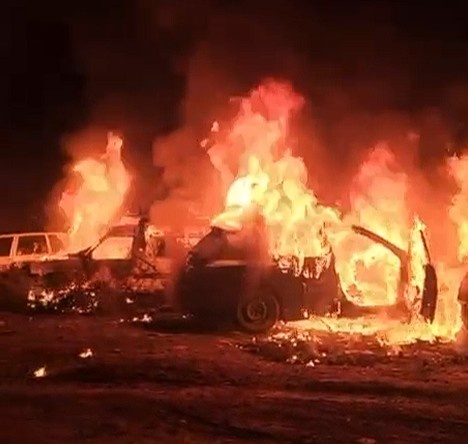
Photos:Scene. Screenshot. Published by IMEMC News
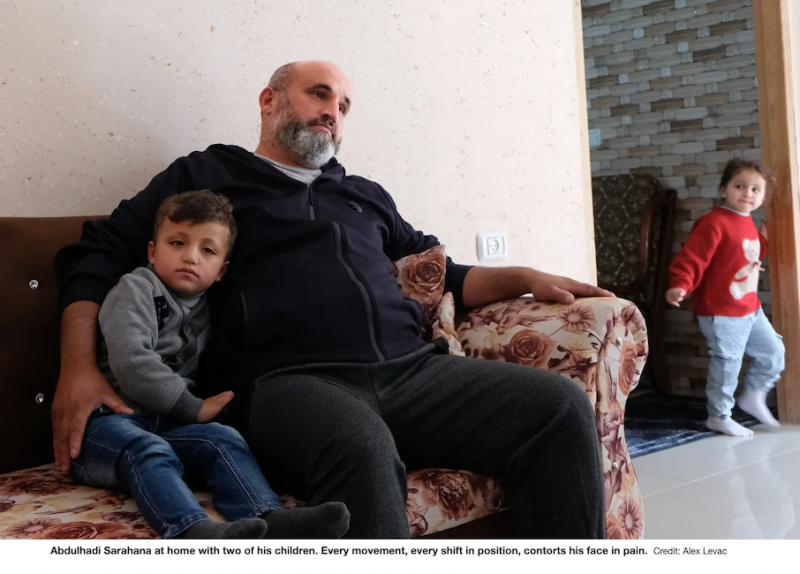
Abdulhadi Sarahana at home with two of his children. Every movement, every shift in position, contorts his face in pain. Credit: Alex Levac. Published by Haaretz
See additional videos at IMEMC & Haaretz News Source links
______
by IMEMC News
Nov 22, 2026
Illegal Israeli paramilitary colonizers escalated their attacks on Palestinians and their property across the occupied West Bank on Saturday, setting fire to homes and vehicles in Deir as-Sudan, and to vehicles in Kafr Malik, in the Ramallah area, assaulting farmers in Burqa, and threatening families in Birin, southeast of Hebron, with forced displacement, while Israeli soldiers fired gas bombs at villagers. Additional attacks were reported in the Jerusalem, Tubas, Nablus, and Salfit governorates.
Colonizers invaded a Bedouin community near the Jaba’ roundabout, north of occupied Jerusalem, home to the Ka’abna and Ara’ra families.
The Jerusalem Governorate said the colonizers carried out provocative acts against the Palestinians, as part of daily attacks, especially at night, aimed at terrorizing the residents, and as part of a systematic policy to pressure them into leaving the community.
Ramallah
Late on Saturday night, Israeli colonizers attacked Deir as-Sudan village, west of Ramallah, and set fire to a number of homes and vehicles, as flames engulfed the cars and houses.
In a separate attack, colonizers set fire to Palestinian vehicles during their assault on Kafr Malik village, northeast of Ramallah.
Colonizers attacked farmers on Saturday morning in Burqa village, east of Ramallah, and forced them to leave their lands before returning to the colonial outpost established east of the village.
The Al-Baidar human rights organization said the attack is part of ongoing restrictions that prevent Palestinian farmers from reaching and cultivating their lands.
In Al-Mughayyir town, east of Ramallah, colonizers attacked the residents in several waves, leading to clashes between the Palestinians and the colonizers. The colonizers also hurled stones at cars in the Marj Su’ plain in the town and smashed the windows of a truck and a car.
In addition, several Palestinian cars were damaged after colonizers hurled stones at them on the bridge between Burqa and Deir Dibwan towns, east of Ramallah.
Later on Saturday evening, Palestinian youths confronted colonizers who attacked the outskirts of Al-Mughayyir, forcing them to withdraw.
Hebron
Armed colonizers attacked the home of Yousef Shannaran in Wadi ar-Rakhim, in Yatta town, and hurled stones at it, causing damage to his property. They also attacked the home of Samir Obeid, trying to break down the door and smash the windows, in Khallet al-Hummus, south of Yatta.
Later, colonizers attacked a Palestinian home that has been under siege for 48 days in Wadi ar-Rakhim, south of Yatta. Osama Makhamra, an anti-colonization activist in southern Hebron, told said the colonizers attempted to break into one of the homes.
In addition, several colonizers invaded Wadi al-A’war area in Birin village, southeast of Hebron, and threatened and terrorized the Palestinians while they were harvesting olives, as soldiers fired tear gas canisters at the Palestinians.
The head of the Birin Village Council, Farid Burqan, told the Palestinian News and Info Agency (WAFA) that a group of armed colonizers, riding horses, invaded the area and carried out provocative acts near the homes of the Palestinians and threatened to forcibly drive them out of the area while they were harvesting olives.
|Saturday Update: West Bank Invasions and Abductions|
Burqan added that the villagers face daily attacks by colonizers from the illegal Adorayim colonial outpost, which was established on Palestinian land southwest of Birin. He said the outpost has become a base for attacks that include destroying crops, damaging and stealing property, stealing livestock, and physically assaulting residents, as well as terrorizing women and children, particularly during night raids.
Furthermore, paramilitary colonizers, accompanied by Israeli soldiers, hurled stones at Palestinian cars on Bypass Road 60, near Wadi ash-Shunnar, north of Hebron, causing damage to the bodies of several cars.
Dozens of colonizers also invaded the Old City of Hebron, accompanied by many soldiers, and carried out provocative tours.
Tubas
In Tubas, colonizers vandalized sheep barns in the Ras al-Ahmar area, in the northern Jordan Valley, owned by Thaer Abdullah Hussein Bsharat.
Nablus
Colonizers also attacked Palestinian homes in the “Bir Qouza” area, on the outskirts of Beita town, south of Nablus.
Salfit
In Salfit, colonizers invaded the “Abu Za’im” area in Yasuf village, east of the city, and harassed the locals.
______
The Israeli Army Razed a Settler Outpost, Then Left Palestinians to Face a Pogrom
In response to the army's evacuation of an illegal outpost, by High Court order, hundreds of settlers attacked Palestinian homes in the village of Atara. The troops had left by then, abandoning the locals to the rampagers
by Gideon Levy and Alex Levac for Haaretz
November 21, 2026
Nighttime. A long convoy of army and police vehicles, including a bulldozer, makes its way through the streets of the village of Atara, near Ramallah in the West Bank. The vehicles are heading for the settler outpost of Kfar Tarfon nearby, which was established in August 2025 in Area B (Palestinian civil control, joint security control) on the villagers' privately owned land.
Two families have already been compelled to evacuate their homes due to the terror of the outpost's inhabitants. They petitioned the High Court of Justice last July through the NGO rights group Yesh Din. The court ordered the state to report on the measures it was taking to ensure the families' security and the return to their homes; they have yet to go back. Finally, last Thursday, Israel Defense Forces troops arrived in the dead of night to remove some of the outpost's huts, demolished two mobile homes and impounded two vehicles.
Hundreds of settlers from outposts in the area then began to gather in protest. After the army left they started to vent their wrath on the residents of Atara, the village victimized by the settlers. The evacuation of the outpost – much of which has since been restored – ended in a pogrom: Over the next two hours Atara was battered.
It seems that just about any incident that occurs in the West Bank these days ends with punishment inflicted on Palestinians.
In his elegant office, Saleh Salameh, head of the village council, recalls the events of that night, between Wednesday and Thursday last week. He feels quite helpless when it comes to helping residents of this clean, nicely kept community that is home to some 3,500 people, below which lies the new Palestinian city of Rawabi.
An array of iron gates installed by the army encircles Atara. From time to time, such as during the settlers' assault, the village is put under total siege. Mohammad Romaneh, a field researcher for B'Tselem – The Israeli Information Center for Human Rights in the Occupied Territories, tells us when we visit this week that he waited two hours at a checkpoint while trying to leave Atara one day last week. There were only five cars ahead of him, but the soldiers took their time checking each vehicle.
Life in this tranquil village has been turned upside down since last year, when the Kfar Tarfon outpost seized control of the hilltop across the way and of all the olive groves below. There hasn't been a quiet day since; personal security is nonexistent, harvesting the olives is out of the question.
At 3 A.M. on Thursday, November 12, Salameh was awakened by residents who called to report that army troops had entered the village and were heading for the outpost. The army's operation there apparently concluded at about 5 A.M.; videos shot by terrified villagers showed a swarm of settlers approaching Atara. The settlers followed in the wake of the IDF convoy, which was leaving by that time, and spread out among the houses, mostly those located on the outskirts of the village.
Over the next two hours the marauders destroyed five vehicles, attacked five dwellings and wounded five residents, one of whom, 67-year-old Samir Kadadha, suffered a serious head injury when he was hit by a stone; he remains hospitalized. Settlers also broke an arm and a leg of his brother, Waal, 52. They also broke 21-year-old Basil Aburagila's leg and broke a bone in the back of Abdulhadi Sarahana, 36; Mohammed Qatairi, 35, was wounded in the shoulder. The villagers under attack called for help and residents gathered in the streets to try to protect their neighbors.
For the next two hours, neither a soldier nor a police officer could be seen, even though there is an IDF observation post at the entrance to Atara, from which it's possible to see anything happening in the vicinity.
Says Salameh, the council head: "If the settlers had reported that one of their group had been hurt, the army would have arrived in large numbers."
When the army did finally show up, and the intruders fled – what did the soldiers do? They fired tear gas and stun grenades at the villagers. Let's keep our priorities straight, right?
The IDF Spokesperson's Unit stated this week, in response to a query from Haaretz: "Security forces completed a repeat enforcement operation at the illegal outpost, from which repeated acts of violence and other illegal activities have originated. As part of the operation, illegal structures and vehicles were removed. Contrary to claims, the following morning, IDF forces quickly arrived in the vicinity of the village of Atara following reports of a confrontation in the area and worked to restore order.
"The troops' presence and activity on the ground prevented the events from escalating. Decisions and the conduct of the forces on the ground were determined in accordance with commanders' situational assessments, and professional and operational considerations. The IDF and Border Police are acting resolutely against this violence. The IDF strongly condemns such incidents, which divert attention from and also undermine the operational and preventive activities of IDF forces."
At about 7 A.M. it was all over. At 8 the army opened one of the village's gates in order to allow the settlers who had arrived from the outpost to disperse, and so that villagers could leave for work.
"We feel like we're in a sitcom," Salameh says bitterly. "The army evacuates the settlers a second time, and the next day they come back and rebuild, even though there is a court order that allows the two families to return home."
The father of one of those families is a U.S. citizen and his wife has Israeli citizenship. Maybe that's why the army is trying to sell the illusion of an evacuation here, in contrast to scores of incidents involving other outposts?
On the day after the incident, a distinguished guest visited Kfar Tarfon: Moshe Feiglin, a newly minted lawmaker from the Religious Zionism party. Clad in a long, dark wool coat, stylish as always, he posted a video in which he congratulated the marauders: "We are in Khirbet Tarfon and we see how the Arab enemy is not only trying to steal our future from us, but also the past. The hilltop pioneers, with heroism and devotion, are preventing this by holding firm. This is the struggle for the future of who will inhabit the heart and core of this land and for whose state will arise here, for whose sovereignty will come into being and will persist in this place. The sovereignty of the Jewish people or the sovereignty of the children of the bondwoman [Genesis 21:10] – I don't know what to call them: Palestinians, they call this invention.
"They are trying to eliminate the past," the MK continued, "and to eliminate the vestiges of Jewish settlement of 2,500 years. The High Court and the army are so clearly leaning toward the Arab side."
It could have been amusing: The children of the "bondwoman," the Palestinians as erasers of the future and the past, and the heart and core of the land in some remote illegal outpost – all surrounded by bustling Palestinian cities. But this insane talk has become standard fare; indeed, maybe it's already the preserve of the majority in Israel.
With Salameh, we went up to the roof of the council building, covered by a forest of solar panels of the Jerusalem District (East Jerusalem) Electricity Company, to look around. On the ridge across the way we saw the dwellings of Kfar Tarfon, which from a distance show no signs of any demolition. To their left are the abandoned houses of the two families who fled Atara. And on the slopes of the hill are olive groves that none of their owners can access. Stretch out an arm – and you won't touch them.
We visited survivors of the attack last week. Abdulhadi Sarahana, a construction worker and father of two, groans with pain in his home. Every movement, every change of posture, and his face contorts with pain. The fourth lumbar vertebra in his spine was shattered by a rock thrown by the settlers.
Last Thursday he was planning to go to work in Ramallah. He knew about the army's activity at the outpost but not about the settlers' reaction. He left home at about 7 A.M. and boarded a shared taxi downtown. At the checkpoint near the entrance to Atara, he and the other passengers were stunned to see hundreds of settlers attacking cars with stones and clubs. Sarahana and the others immediately got out and ran for their lives, joining other passengers in cars at the checkpoint. But just as he left the vehicle a rock struck him in the back, toppling him to the ground. He was the first casualty of the assault.
A private car evacuated him to a medical clinic in Rawabi – the road to Ramallah was blocked – and from there an ambulance managed to get him to a hospital in Ramallah, where a CT revealed the shattered bone. He laments that he doesn't know how he will provide for his family; his recovery will take at least four months.
This is the second time Sarahana has been attacked by settlers within about half a year. Around six months ago, he and others from the village volunteered to repair a well. Settlers appeared immediately, prevented the repair work and beat the Palestinians.
At the Varno paint factory near the entrance to the village, work was underway this week to extend the wall around it; the invaders had pelted the courtyard with stones during the pogrom. The damage is even worse in a two-home compound close by, which is accessed via an electric gate and is where the homes of the Qatairi brothers and their families are located. One-story stone houses with spacious yards. Settlers broke in and smashed almost all the windows in the houses, in an apparent attempt to enter them. Imagine: women and little children cowering inside, dozens of settlers throwing stones at their homes, destroying property and threatening to break in. Imagine the level of fear.
By last Friday, Daoud Qatairi had already installed thick, closely spaced bars on all the windows of his house. Broken floodlights and CCTV cameras are still lying about, as are fragments of glass; rolls of barbed wire are waiting to be affixed to the fences. The family's Nissan is smashed on all sides.
"They've turned my home into a prison," says Daoud, who's 56 and works as a driver for the Palestinian Authority.
The settlers disabled the electric motor that operates the entry gate and were thus able to storm the yard. Also accessible now is the yard of the house of Daoud's 50-year-old brother, Basil, who recently suffered a stroke and is undergoing rehab in Ramallah. His wife and their 16-year-old daughter now hide in the darkened house, afraid to open the door to strangers. Broken glass is all over here too, and one of the two white water containers on the roof was smashed last week. The daughter, Lujain, tells us she was attacked once by settlers on the way to school.
The dread is palpable.
News Source Link
https://imemc.org/article/colonizers-continue-attacks-across-the-occupied-west-bank/https://www.haaretz.com/israel-news/twilight-zone/2026-11-21/ty-article-magazine/.highlight/israeli-army-razed-a-settler-outpost-then-left-palestinians-to-face-a-pogrom/000001a1-fce4-d02c-a7eb-fde6565c0000
https://imemc.org/article/30-colonist-attacks-across-west-bank-in-24-hours/
https://www.jpost.com/israel-news/article-915728
https://en.wikipedia.org/wiki/Deir_as-Sudan
https://en.wikipedia.org/wiki/Kafr_Malik
https://en.wikipedia.org/wiki/Burqa,_Ramallah
https://peacenow.org.il/en/settlements/settlement1132-en
https://www.google.com/search?q=Birin%2C+Hebron+wiki&rlz=1C5CHFA_enUS1109US1109&oq=Birin%2C+Hebron+wiki&gs_lcrp=EgZjaHJvbWUyBggAEEUYOTIJCAEQIRgKGKABMgkIAhAhGAoYoAEyCQgDECEYChigATIHCAQQIRiPAtIBCDM3OTlqMGo3qAIAsAIA&sourceid=chrome&source=chrome.ob&ie=UTF-8&
https://en.wikipedia.org/wiki/Al-Mughayyir,_Ramallah
https://en.wikipedia.org/wiki/Deir_Dibwan
https://en.wikipedia.org/wiki/Yatta,_Hebron
https://en.wikipedia.org/wiki/Khirbet_ar-Ras_al-Ahmar
https://en.wikipedia.org/wiki/Beita,_Nablus
https://en.wikipedia.org/wiki/Yasuf
https://mapcarta.com/12909368
https://www.machsomwatch.org/content_daily_report/%D7%97%D7%9C%D7%AA-%D7%90%D7%9C-%D7%97%D7%95%D7%9E%D7%95%D7%A1-%D7%9E%D7%AA%D7%A0%D7%97%D7%9C%D7%99%D7%9D-%D7%9E%D7%9E%D7%90%D7%97%D7%96-%D7%97%D7%93%D7%A9-%D7%9E%D7%A8%D7%A1%D7%A1%D7%99%D7%9D/
Features
Israeli settlers set fire to homes and vehicles late at night, 11/21/2026
Israeli settlers set fire to vehicles during an assault on the village, 11/21/2026
Israeli settlers attacked farmers & forced them off their lands; cars damaged by stones on Burqa–Deir Dibwan bridge, 11/21/2026
Israeli settlers attacked residents in several waves, sparking clashes; stoned cars in Marj Su' plain, smashing windows of a truck & a car, 11/21/2026
Several Palestinian cars damaged by settlers' stones on the bridge between Burqa & Deir Dibwan, 11/21/2026
Armed settlers stoned & damaged Yousef Shannaran's home in Wadi ar-Rakhim; tried to break into a home under 48 day siege, 11/21/2026
Outpost on Birin land named as base for daily attacks: crop destruction, property and livestock theft, assaults, night raids, 11/21/2026
Israeli settlers, with soldiers, stoned Palestinian cars on Bypass Road 60, damaging several vehicles, 11/21/2026
Israeli settlers vandalized sheep barns owned by Thaer Abdullah Hussein Bsharat, northern Jordan Valley, 11/21/2026
Israeli settlers attacked Palestinian homes in the Bir Qouza area on the town's outskirts, 11/21/2026
Israeli settlers invaded the Abu Za'im area and harassed residents, 11/21/2026
| Credibility: |  |
 |
0 |
Additional Reports
Israeli forces detain 15 Palestinians from across the West Bank
03:00 Jan 13, 2016
Hebron, al-Jalazun, Qabalan, Jerusalem's Old City and Shu'fat, 0.17 Kms
Army Abducts Seven Palestinians In The West Bank
06:00 May 06, 2018
Hebron, Beit Ummar, Deir al-Hatab, and Jerusalem, 0.21 Kms
Army Forces A Palestinian To Demolish His Home In Jerusalem
12:00 Oct 03, 2021
Beit Hanina ( بيت حنينا ), 0.26 Kms
Israeli Forces Arrest Fourteen Palestinians, Including Two Children
03:00 Jun 21, 2020
al-Issawiya (Isawiya), Beit Ummar, Al-Mazraa Al-Gharbiyyah, and Dura Al-Qara, 0.28 Kms
IOF nabs two men including minor in continued West Bank arrest sweep
06:00 Jul 26, 2011
Husan (Hussan) village, near Bethlehem and Aboud village in Ramallah province, 0.45 Kms


Leave a Comment