
Palestine Crisis Map
Sept 17, 2015: Israel OK's sniper fire against stones. 2015-2020: ~100,000 more Israeli settlers move to West Bank & Jerusalem. Jan 2022-Sept 2023: ~404 Palestinians, 58 Israelis killed. 10/7/23 to date: ~73,700+ Palestinians, ~1,850 Israelis killedVerified
West Bank: 37 Abducted, Olive Farmers Attacked
12:00 Oct 22 2026 Burqin (برقين), Muthallath ash-Shuhada (مثلث الشهداء), Jaba’ (جبع), Silat al-Harithiya (سيلة الحارثية), Tuqu’, Wadi Abu Freiha, Hebron, Ma’in, al-Jwaya, Urif, Burin, Nablus, Qalandia camp & more...
Detention Internal Travel Controls, Restrictions/Closures Property, Infrastructure, Services, Taxes: Disrupted, seized or destroyed Home Invasions Military Assault on Confined Civilian Population Collective Punishment Vineyards Destroyed Fields Burned/Razed/flooded Vandalism/Theft Physical assaults
Description
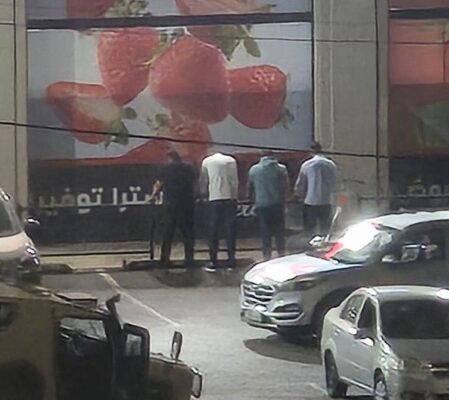
Photo:Scene. Screenshot. Published by IMEMC News
See videos at IMEMC News Source Link
_____
by IMEMC News
Oct 23, 2026
Israeli occupation forces abducted at least 26 Palestinians and 11 solidarity activists across the occupied West Bank on Thursday, while illegal paramilitary Israeli colonizers attacked olive farmers, stole harvests and equipment, and damaged trees. Military invasions and road closures also restricted movement and access to farmland, and colonizers attacked a Palestinian Red Crescent Society ambulance responding to reported injuries in al-Mughayyir.
In Jenin Governorate, in the northern West Bank, the Palestinian Prisoners’ Society (PPS) reported that Israeli occupation forces abducted ten Palestinians at dawn after breaking into their homes in several towns and villages.
Those abducted included Rukn Masharqa, displaced from Jenin refugee camp and residing in Burqin, and Rabea’ al-Wishahi, from Muthallath ash-Shuhada village. In Jaba’, soldiers abducted Fayez ash-Shunnar and his son Mohammad, along with Walid ash-Shunnar and his sons Nasser and Abed.
Soldiers also abducted Amin Khazem and his son Mahdi, both displaced from Jenin refugee camp, as well as Fadi Awadin, also displaced from the camp and residing in Silat al-Harithiya.
Local sources also reported that Israeli occupation forces invaded Deir Abu Da’if village, east of Jenin city. Israeli occupation forces also invaded Meithalun town, south of Jenin. Separately, the forces fired illumination flares over the Marj Ibn Amer Plain in Jenin.
In a separate attack in Jenin, illegal paramilitary Israeli colonizers beat Fadi Abu Bakr while he was harvesting olives, requiring his transfer to a hospital for treatment.
Tareq Ighbariya, the official responsible for monitoring colonization in Jenin Governorate, said Israeli occupation forces continued bulldozing Palestinian land east of Jenin for a second consecutive day to build a colony road linking Homesh and Tarsala colonies. The work cut off the main paved road connecting Silat ad-Daher and al-Atara, south of Jenin.
In Khirbet al-Mikahel, part of Ya’bad, west of Jenin, colonizers attacked olive farmers and surrounded them with two vehicles, forcing them to leave 17 sacks of olives behind. Local sources said the colonizers stole the sacks and harvesting equipment, including electric motors, hoses, and ground sheets.
Ighbariya also reported that Israeli occupation forces closed the Deir Ghazala road on the Jenin city side, secondary entrances along the bypass road, and most gates leading to villages in the eastern governorate. Soldiers also prevented farmers from reaching their land in Barta’a.
In Bethlehem Governorate, media sources reported that Israeli occupation forces abducted six Palestinians. Among them was Shorouq Mohammad Mousa al-Badan, 32, a former political prisoner, whom soldiers abducted during an invasion of Tuqu’, southeast of Bethlehem, as forces deployed in several neighborhoods.
In Wadi Abu Freiha, east of Bethlehem, soldiers abducted Mohammad Saleh Abu Aker, 42, and Bilal Adel Ahmad Jado, 42, both from Beit Sahour; Amir Lutfi Khalil Sa’ad, 39, and Fares Jibrin Atiyya Hasanat, 49, both from Dheisheh refugee camp; and Othman Abd Salem ash-Shawawra, 21, from ash-Shawawra, east of Bethlehem.
A local source reported that two Palestinians suffered bruises and wounds on Thursday evening after colonizers beat them while they were harvesting olives near the entrance to Marah Rabah, south of Bethlehem.
Several Palestinians also suffered the effects of tear gas inhalation after Israeli occupation forces invaded Aida refugee camp, north of Bethlehem, positioned themselves near the cemetery, and fired tear gas toward homes and passersby. A local source said those affected received treatment at the scene.
For a second consecutive day, soldiers kept northern Bethlehem closed with concrete blocks near the Bilal bin Rabah Mosque, restricting movement within the city. They also installed a military roadblock at the western entrance to Battir, west of Bethlehem, searched vehicles, checked identity cards, and obstructed traffic.
Israeli occupation forces also invaded Beit Fajjar and Marah Rabah, south of Bethlehem, and deployed in several neighborhoods. No home invasions or abductions were reported during those incursions.
Media sources reported that soldiers abducted Salim Zaher al-Atrash in Hebron city after invading several neighborhoods, breaking into his home, searching it, and ransacking its contents.
In Masafer Yatta, soldiers abducted Khader Mos’ef and his son Suleiman while they were trying to reach Khader’s land in Wadi Ma’in to harvest olives, according to activist Osama Makhamra.
In Khirbet Jawaya, Israeli occupation forces abducted three more farmers and 11 solidarity activists from the Fazz’a campaign, according to The Wall & Colonization Resistance Commission.
In Wadi Ma’in, Masafer Yatta, colonizers invaded land belonging to the Mos’ef family, harvested olives, and stole them. In Birin, east of Hebron, colonizers entered farmland late Wednesday night, picked and stole olives, and damaged and broke trees.
In ar-Rahniya, south of Yatta, colonizers forced farmers off their land and seized the olive harvest belonging to the families of Bashar, Jawad, Ibrahim, and Mohammad Khalil al-Masri.
The Wall & Colonization Resistance Commission also reported that colonizers attacked olive harvesters in Shu’ab al-Batem, threw the olives onto the ground, and trampled them.
In Nablus Governorate, in the northern West Bank, soldiers abducted Mo’taz Hamdan Mustafa Ka’bi, from Urif, and Ahed Nasser Zaben, from Burin. Security sources reported that Israeli occupation forces invaded Awarta, Urif, and Burin, broke into homes, searched them, and ransacked their contents.
Local sources also reported that Israeli occupation forces abducted Dia’ Istaitia, from Nablus, after summoning him for interrogation at the Huwwara military camp, bringing the number of Palestinians reported abducted in the governorate to three.
In al-Mas’udiyya, on land belonging to Burqa, northwest of Nablus, colonizers attacked the home of Mousa D’eis with stones and fired shots nearby on Thursday evening. Thiab Hajji, head of the al-Mas’udiyya Land Defense Committee, said no injuries were reported and that residents confronted the attackers and forced them to leave.
In al-Lubban ash-Sharqiyya, south of Nablus, colonizers invaded agricultural land under the protection of Israeli occupation forces and threatened farmers with weapons, demanding their olive harvest. When the farmers refused, the colonizers threw the olives onto the ground and seized ground sheets, ladders, and harvesting machines.
The Commission also reported that colonizers attacked farmers and fired toward them in Wadi ash-Shami, between Asira al-Qibliya and Madama. In Yasid, colonizers prevented residents from harvesting olives and forced them off their land under military protection.
In addition, Israeli occupation forces closed the Surra and Route 17 military roadblocks around Nablus on Thursday morning, preventing vehicles from entering or leaving through them. Soldiers also invaded Beit Furik, east of Nablus, broke into a home, and searched it; no abductions were reported during that invasion.
In Jerusalem Governorate, Israeli occupation forces abducted Ramzi al-Louzi after breaking into and searching his home during an invasion of Qalandia refugee camp, north of occupied Jerusalem, according to the Jerusalem Governorate.
Israeli occupation forces also invaded Qarawat Bani Hassan town, west of Salfit, in the central West Bank.
Local sources reported that colonizers pursued and attacked olive harvesters and international solidarity activists in Wadi Yasuf, also known as al-Wadi al-Ahmar, near Jamma’in, east of Salfit. They forced the harvesters and activists to leave the valley and abandon the olives. The sources said harvesters in the area face repeated daily attacks under military protection.
In Ramallah Governorate, in the central West Bank, the Palestinian Red Crescent Society (PRCS) reported that Israeli colonizers attacked one of its ambulances as it headed to al-Mughayyir village in response to reports of injuries caused by a colonizer attack.
The PRCS said the attack damaged the ambulance and shattered its windows. Local sources also reported that colonizers threw stones at vehicles near al-Mughayyir village’s entrance, damaging at least two.
Residents confronted colonizers attempting to attack homes in the western part of al-Mughayyir and forced them to flee. Israeli occupation forces then invaded the area and fired shots, concussion grenades, and tear gas.
Elsewhere in Ramallah and al-Bireh Governorate, the Commission reported that colonizers pursued farmers harvesting olives in Atara and forced them to leave. Colonizers also cut down olive trees on land belonging to Burqa village and released livestock onto olive-growing land in Kafr Malik.
Northwest of Ramallah, Israeli occupation forces closed the Nabi Saleh gate and the gate at the Atara military roadblock, while tightening restrictions at the Aboud and Ein Siniya military roadblocks.
Intensive searches at Aboud caused severe congestion, forcing thousands of Palestinians to take long alternative routes. The Nabi Saleh gate serves Nabi Saleh, the western Bani Zaid villages of Beit Rima, Deir Ghassana, Kafr Ein, and Qarawat Bani Zaid, as well as Salfit city and several surrounding villages.
In Qalqilia Governorate, the Commission reported that colonizers, protected by Israeli occupation forces, burned olive trees in ash-Shab’at, on land belonging to Immatin, east of Qalqilia, while farmers were forced to leave their fields and prevented from completing the harvest. Colonizers also attacked farmers in al-Wadat, on land belonging to Hajjah village, attempting to force them to leave.
Israeli occupation forces also invaded the northern area of Kafr Qaddum, forced farmers off their land, and barred them from remaining there. Soldiers forced farmers to leave the al-Jabal area near Immatin and detained Yousef Jom’a and several of his workers.
In Tubas Governorate, Israeli occupation forces invaded Tubas city with several vehicles and deployed in its streets, with infantry soldiers taking positions in the city center. They later withdrew and invaded al-Far’a refugee camp to the south. No home invasions or abductions were reported during either incursion.
For the broader October 1–21, 2026 period, The Wall & Colonization Resistance Commission said in a statement issued Thursday that it documented 409 attacks by Israeli occupation forces and colonizers against olive farmers, trees, land, and harvesting equipment.
It attributed 317 attacks to colonizers and 92 to the military. The Commission said the attacks ranged from blocking access to fields and forcing farmers to leave to stealing harvests and destroying trees and equipment.
Nablus recorded 166 attacks, followed by Salfit with 91, Ramallah and al-Bireh with 69, Jenin with 36, Hebron with 30, Qalqilia with nine, Bethlehem with five, and Jerusalem with three. Nablus and Salfit together accounted for approximately 63 percent of the total.
The Commission recorded 287 attacks directly targeting farmers, including the fatal shooting of Ali Hasan Bazzari, from Burqa, northwest of Nablus, who died on October 7, 2026, from injuries sustained when colonizers shot him while he was harvesting olives.
The other recorded attacks comprised 149 incidents of intimidation, 50 beatings, 29 restrictions on movement or access to land, 18 abduction incidents during harvesting, 15 incidents of detention inside olive fields, 14 incidents involving pepper spray or grenades fired toward farmers, and 11 shootings.
Among the incidents documented during that period, colonizers attacked olive harvesters in Ma’in, Masafer Yatta, under military protection on October 17. One Palestinian was shot in the thigh, while two others suffered fainting and burns after being sprayed with pepper spray. On October 16, three farmers suffered wounds and bruises in a colonizer attack in Asira al-Qibliya, and farmers were also injured in Beita.
Another 122 attacks targeted trees, land, equipment, and other property associated with the harvest. These included 57 thefts of olives, 23 seizures or thefts of agricultural equipment, 12 incidents of breaking olive trees, 11 incidents of cutting down or uprooting trees, seven burnings of olive-growing land, five incidents of damage to trees, four burnings of property, and three incidents of bulldozing land.
The Commission’s documented cases included an October 16 attack in Qabalan, where colonizers overturned a Palestinian’s vehicle and stole sacks of olives. In Rantis, farmers were detained for more than two hours, and Israeli occupation forces seized two sacks of olives and two harvesting machines.
For Thursday’s reporting window of 6 a.m. to 6 p.m., the Commission recorded 17 attacks against farmers and their land across Hebron, Qalqilia, Nablus, Ramallah and al-Bireh, Jenin, and Salfit governorates.
News Source Link
https://imemc.org/article/update-army-abducts-26-palestinians-11-activists-in-west-bank/https://imemc.org/article/commission-documents-409-israeli-attacks-during-olive-harvest/
https://en.wikipedia.org/wiki/Burqin,_Palestine
https://en.wikipedia.org/wiki/Ash-Shuhada
https://en.wikipedia.org/wiki/Jaba%27,_Jenin
https://en.wikipedia.org/wiki/Silat_al-Harithiya
https://en.wikipedia.org/wiki/Silat_ad-Dhahr
ttps://en.wikipedia.org/wiki/Al-Attara
https://en.wikipedia.org/wiki/Homesh
https://en.wikipedia.org/wiki/Sa-Nur
https://en.wikipedia.org/wiki/Tuqu%27
https://en.wikipedia.org/wiki/Battir
https://en.wikipedia.org/wiki/Hebron
https://en.wikipedia.org/wiki/Ma%27in,_Hebron
https://en.wikipedia.org/wiki/Urif
https://en.wikipedia.org/wiki/Burin,_Nablus
https://en.wikipedia.org/wiki/Nablus
https://en.wikipedia.org/wiki/Al-Lubban_ash-Sharqiya
https://en.wikipedia.org/wiki/Qalandia_Camp
https://en.wikipedia.org/wiki/Al-Mughayyir,_Ramallah
https://www.ochaopt.org/content/masafer-yatta-communities-risk-forcible-transfer-june-2022
Features
Rukn Masharqa detained 10/22/2026
Rabea’ al-Wishahi detained 10/22/2026
Fayez ash-Shunnar, Mohammad ash-Shunnar, Walid ash-Shunnar, Nasser ash-Shunnar, and Abed ash-Shunnar detained 10/22/2026
Fadi Awadin detained 10/22/2026
Shorouq Mohammad Mousa al-Badan detained 10/22/2026
Mohammad Saleh Abu Aker, Bilal Adel Ahmad Jado, Amir Lutfi Khalil Sa’ad, Fares Jibrin Atiyya Hasanat, & Othman Abd Salem ash-Shawawra detained 10/22/2026
Salim Zaher al-Atrash detained 10/22/2026
Khader Mos’ef, Suleiman Mos’ef detained 10/22/2026
Three farmers and 11 Fazz’a campaign solidarity activists abducted 10/22/2026
Israeli settlers seized olive harvest of the Bashar, Jawad, Ibrahim and Mohammad Khalil al-Masri families 10/22/2026
Mo’taz Hamdan Mustafa Ka’bi detained 10/22/2026
Ahed Nasser Zaben detained 10/22/2026
Dia’ Istaitia detained 10/22/2026
Israeli settlers threatened farmers at gunpoint, dumped olives, seized equipment 10/22/2026
Ramzi al-Louzi detained 10/22/2026
Israeli settlers attacked PRCS ambulance and stoned vehicles; forces fired tear gas 10/22/2026
| Credibility: |  |
 |
0 |
Additional Reports
Army Abducts 21 Palestinians In The West Bank
03:00 Oct 02, 2018
Tulkarm, Hebron, Meithalun, Jalqamūs, al-Asakra, Abu Dis, Hizma, Jerusalem, 0.24 Kms
Israeli army detains ten Palestinians in West Bank
06:00 Mar 16, 2016
Beit Ummar, As-Sawahira ash-Sharqiya, Shu'fat, Beit Iba, Asira al-Qibliya, Huwwara checkpoint,, 0.46 Kms
Israeli soldiers detain 21 Palestinians In West Bank; One Palestinian killed
03:01 Dec 09, 2015
Hebron, Jenin, al-Karama (Allenby) crossing, Qalqilia, Tulkarem, Qaryout, Al-Mughayyir, Jerusalem, Deheisheh, 0.47 Kms
Soldiers detain twelve Palestinians In West Bank
12:00 Jul 21, 2015
Bani Naim, Hebron's Old City, 'Asira, Kafr Qalil, Burqin, Jerusalem, 0.56 Kms
Israeli Soldiers Kill A Palestinian Near Ramallah
18:00 Oct 18, 2023
Dura al-Qar' (دورا القرع), 0.56 Kms


Leave a Comment