
Palestine Crisis Map
Sept 17, 2015: Israel OK's sniper fire against stones. 2015-2020: ~100,000 more Israeli settlers move to West Bank & Jerusalem. Jan 2022-Sept 2023: ~404 Palestinians, 58 Israelis killed. 10/7/23 to date: ~73,700+ Palestinians, ~1,850 Israelis killedVerified
Netanyahu: Israeli Forces to Expand Gaza Control to 70 Percent
00:00 May 28 2026 Gaza (قطاع غزة)
Description
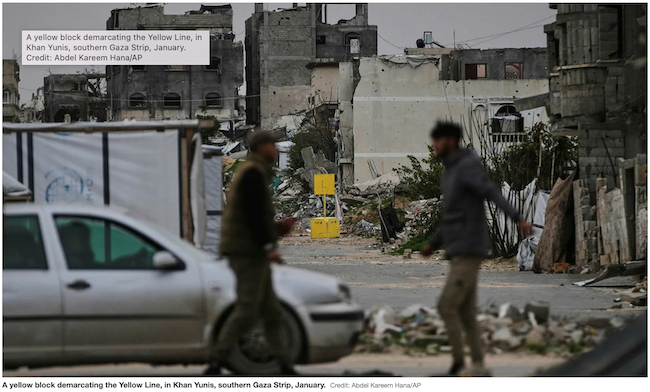
Photos:A yellow block demarcating the Yellow Line, in Khan Yunis, southern Gaza Strip, January. Credit: Abdel Kareem Hana/AP. Published by Haaretz
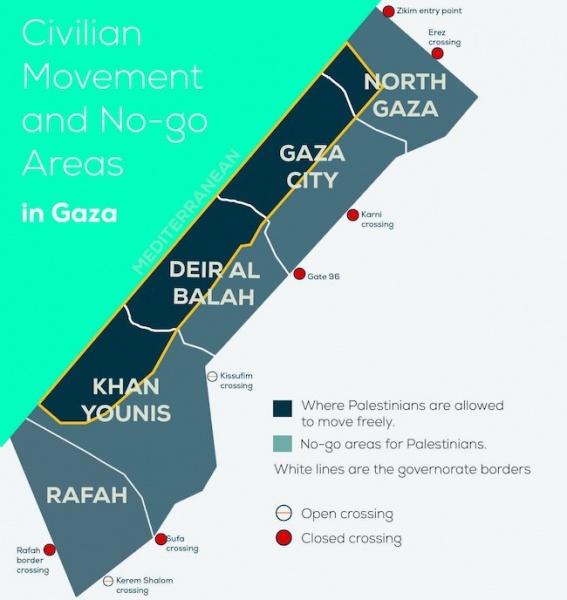
Map: Civilian Movement and No-Go Areas in Gaza: Posted by Ihab Hassan on Twitter (X)
_______
Reuters
May 29, 2026
Published by Haaretz
Prime Minister Benjamin Netanyahu said on Thursday he had directed Israel's military to take more of Gaza, initially by seizing 70 percent of the Palestinian territory, where the population is already penned into a tiny strip of land along the coast.
Israel effectively controls an estimated 64 percent of the tiny coastal Strip, bombarded to ruins by Israel's two-year military assault that followed the 2023 Hamas attack on southern Israel.
Under an October U.S.-brokered truce that has failed to halt Israeli attacks or secure Hamas' disarmament, Israeli troops were meant to withdraw to a Yellow Line demarcating the extent of their control. Marked on military maps, that line put Israel in control of some 53 percent of Gaza, with Hamas ruling the rest.
Reuters has reported that Israel has unilaterally moved the concrete blocks marking the Yellow Line on the ground deeper into Hamas-controlled territory. Maps issued by the military in March showed an even bigger restricted area that analysts say cordons off around 64 percent of Gaza's territory in total.
Netanyahu has repeatedly said in public remarks that the military controls more than 60 percent of Gaza. Speaking to a conference in a settlement in the occupied West Bank, the Israeli leader said even more of Gaza would be taken.
"We were at fifty, we moved to sixty. My directive is to move to - let's go step by step," Netanyahu said on Thursday.
"First of all, seventy. Let's start with that. We're pressing them (Hamas) from all sides. We'll deal with the remnants."
____
via Twitter (X)
Ihab Hassan
@IhabHassane
Netanyahu says he told the Israeli army to occupy 70% of Gaza.
This is the new map of Gaza.
Nearly 2 million people — most of them displaced — will be crammed into just 110 square kilometers. That is more than 18,000 people per km².
News Source Link
https://www.haaretz.com/israel-news/israel-security/2026-05-29/ty-article/netanyahu-i-ordered-israeli-forces-to-expand-gaza-control-to-70-percent/0000019e-713a-d84e-a3be-f53b25440000https://x.com/IhabHassane/status/2060138776123301924
https://en.wikipedia.org/wiki/Gaza_peace_plan
| Credibility: |  |
 |
0 |
Additional Reports
IDF: 'Forbidden zone' in Gaza three times larger than previously stated
12:00 May 12, 2013
Gaza, 0.26 Kms
IOF Tightens Gaza Strip Closure, Gaza Sea Completely Closed and Fishermen Denied Work
06:00 Aug 16, 2020
Occupied Palestinian Territories (oPT): Gaza, 0.37 Kms
Israeli Army Fires Many Missiles And Shells Into Several Areas In Gaza
06:00 Feb 13, 2023
Beit Hanoun ( بيت حانون) and Khan Younis (خان يونس), 0.51 Kms
Israeli Soldiers Fire Missiles Into The Gaza Strip
06:00 May 06, 2020
Juhor a-Dik and Beit Hanoun (Hanun), 0.55 Kms


Leave a Comment