
Palestine Crisis Map
Sept 17, 2015: Israel OK's sniper fire against stones. 2015-2020: ~100,000 more Israeli settlers move to West Bank & Jerusalem. Jan 2022-Sept 2023: ~404 Palestinians, 58 Israelis killed. 10/7/23 to date: ~73,700+ Palestinians, ~1,850 Israelis killedVerified
Settler attack on Palestinian hamlet included brutal sexual assault — report
01:00 Mar 13 2026 Khirbet Humsa (خربة حمصة الفوقا)
Description
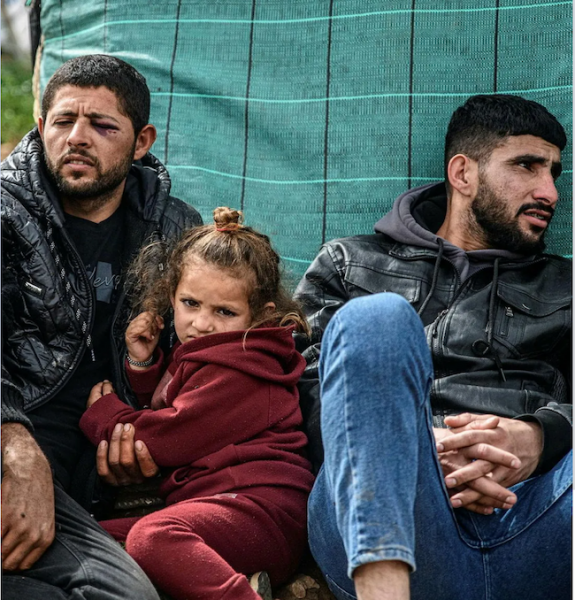
Photos: Published by HaaretzResidents of the community over the weekend. "The women were also bound, and the children were beside us. They had knives and clubs," said one resident. Published by Haaretz
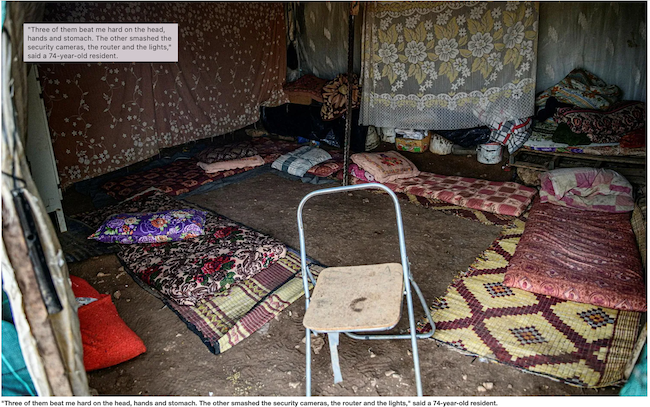
"Three of them beat me hard on the head, hands and stomach. The other smashed the security cameras, the router and the lights," said a 74-year-old resident. Published by Haaretz
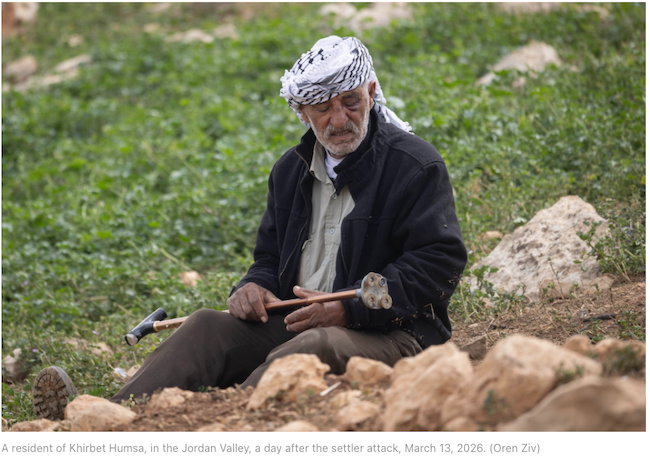
A resident of Khirbet Humsa, in the Jordan Valley, a day after the settler attack, March 13, 2026. (Oren Ziv) Published by 972Mag
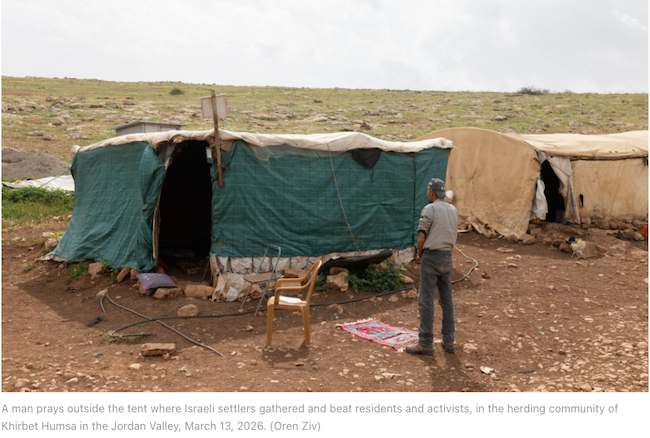
A man prays outside the tent where Israeli settlers gathered and beat residents and activists, in the herding community of Khirbet Humsa in the Jordan Valley, March 13, 2026. (Oren Ziv) Published by 972Mag
____
The Times of Israel
16 March 2026, 11:41 pm
An attack by extremist settlers on a Palestinian hamlet in the northern Jordan Valley over the weekend included a violent sexual assault, Haaretz reports, citing witness testimony.
“They pulled down the Palestinian man’s pants, poured water all over him, and brutally beat him into the dirt,” an American activist who was on site during the attack in Khirbet Humsa tells Haaretz.
“All he could do was curl into a fetal position and scream when they beat him with their clubs,” she recalls. “It was one of the worst things I’ve ever seen.”
Against the backdrop of near-daily settler attacks that have gone largely unchecked by the Israeli government, a small, but growing number of activists from Israel and abroad have started taking part in a practice known as “protective presence” in some of the Palestinian communities that have been under frequent attack.
Haaretz also speaks with several Khirbet Humsa residents, with one of them recalling her own assault.
“I woke up to the settlers’ shouts. They slapped me and dragged us outside, bound us, tore off my head covering, and ripped some of my clothes.”
“They pulled the girls out and beat them, even the little ones. They mocked us and celebrated our humiliation,” she says.
The oldest victim, a 74-year-old male, tells Haaretz, “Three of them beat me hard on the head, hands, and stomach. The other smashed the security cameras, the router and the lights.
“I started to lose consciousness. They poured water on me, and during this time, one settler stole the watch from my hand,” he adds.
Haaretz says that the Shin Bet is investigating the attack.
____
Israeli Settlers Sexually Assaulted Palestinian Man in Jordan Valley, Witnesses Say
Witnesses to the weekend raid on the community of Khirbet Humsa, involving dozens of settlers, describe a nightmare that lasted about an hour and also included violence against young girls in front of their bound parents and the looting of livestock and jewelry
by Matan Golan for Haaretz
12:45 PM • March 16 2026 IST
Settlers who raided Khirbet Humsa, a Palestinian community in the northern Jordan Valley, over the weekend, severely sexually assaulted a man in front of his family, according to witnesses.
Testimonies say the settlers also beat girls and teenage girls in the community, and one of them threatened to kill the children and rape the women. Four men from the community and two female human rights activists were evacuated for medical treatment. Haaretz has learned that the Shin Bet is involved in investigating the incident.
Residents of Khirbet Humsa who were present during the attack, along with a human rights activist who was with them, described to Haaretz what they said was a severe series of abuses lasting about an hour. According to their accounts, the raid began around 1 A.M., when dozens of masked settlers arrived. Several testimonies indicate that the settlers split into groups of three to six assailants and simultaneously stormed structures throughout the community.
"I woke up to the settlers' shouts. They slapped me and dragged us outside, bound us, tore off my head covering, and ripped some of my clothes," a woman from the community testified. "They pulled the girls out and beat them, even the little ones. They mocked us and celebrated our humiliation."
Another resident, whose face was covered in fresh bruises and now requires a walking stick after the attack, recounted: "They came to my home, and I tried to escape, but they caught me. They cut me with a knife above the wrist and bound my hands and feet with a zip tie."
During the conversation, about 36 hours after the attack, he still had an improvised bandage wrapped around his hand, and the marks of the zip ties were still visible on his skin.
The man said one group of settlers began releasing the livestock from the pen while another group attacked his brother.
"They poured cold water on us and threw us to the ground while we were bound, then piled us on top of each other inside the structure, men, women and children," he said. "The women were bound as well, and the children were beside us. They had knives and clubs."
Another resident said settlers beat him on the head and legs, then slammed him against an iron pole before dragging him to a tent where he was bound.
The eldest family member, 74, described how four settlers entered his tent.
"Three of them beat me hard on the head, hands and stomach. The other smashed the security cameras, the router and the lights," he said. "I started to lose consciousness. They poured water on me, and during this time one settler stole the watch from my hand."
Afterward, he said, the rest of the family members were dragged to the tent, which became a kind of central holding point.
"I was sure they were going to rape me"
Meanwhile, in another tent were one resident and two human rights activists volunteering in the West Bank as part of a protective presence program – one American and one Portuguese.
One of them, an American citizen, testified to Haaretz:
"I woke up... to my friend screaming at us to get up before immediately being swarmed and trapped in the tent by about six masked Israeli settlers armed with heavy wooden sticks. They immediately beat the three of us to the ground, smashing our faces with their fists and clubs. They zip-tied our hands and feet and were yelling things like, 'We are going to kill you!'"
At this point, she said, she witnessed the severe sexual assault of the man in the tent. He confirmed the details but asked not to share them in full.
___
‘I thought we were going to be raped’: A night of settler terror in the Jordan Valley
Settlers tied up and beat Palestinians and activists in the herding community of Humsa while sexually assaulting one man, amid a wave of attacks in the area.
by Oren Ziv for 972Mag
March 17, 2026
On the night of March 12, Israeli settlers raided the residential compound of the Abu Al-Kbash family in the Palestinian herding community of Khirbet Humsa in the northern Jordan Valley. They then forced residents and international protective presence activists into a tent, where they were tied up and abused for about an hour.
Around 10 adults and seven children were held inside the tent, according to witnesses. The attackers beat them with clubs, poured cold water on them, threatened them, and sexually assaulted one of the residents. Four Palestinians and two international activists were later taken to hospital in the nearby city of Tubas.
The attack comes amid escalating violence and displacement in the northern Jordan Valley, where Palestinian herding communities have faced mounting pressure from Israeli settlers and the military. In recent weeks alone, at least four communities in the area have been forced to leave their homes.
Odeh family — Ali, 37; his wife Wad, 35; and their sons Othman, 7, and Muhammad, 5 — were shot dead as they returned from Nablus, where they had gone to shop for Eid Al-Fitr, unaware that an undercover Israeli unit was operating in the village.
Home to about 20 residents, Khirbet Humsa is one of the few communities still remaining in the area. Settlers enter its lands almost daily, while the army frequently detains Palestinians grazing their sheep in areas settlers claim as their own.
According to four witnesses who spoke to +972 — all of whom asked to remain anonymous for fear of reprisal — the attack began late at night and involved dozens of settlers. A., who is about 40 years old, said a large group arrived at the first house in the village around 1 a.m.
“I tried to run away, but they caught me, beat me, cut my hand with a knife, and tied my hands and feet with plastic zip-ties,” he told +972, showing the marks left on his arms and legs. “They were all masked except for one. We recognized him.”
Another group of settlers stormed the sheep pens. “They opened the pens and released the sheep,” he said. “Others went to my brothers, beat them, and poured cold water on them.”
The attackers, armed with clubs and knives, forced the residents into a tent in the center of the community. “They gathered us in one room — men, women, and small children,” A. said. “No one was left outside. They threw us onto the concrete floor on top of one another. They tied the women too and kept beating us.”
According to A., some of the attackers spoke Arabic. “They said: ‘Today we’ll take your sheep, but next time we come we’ll burn the houses, kill the children, and rape the women.’”
D., another resident, said he heard the same threat. “They shoved me against an iron pole, dragged me into the tent, and beat me,” he said.
Another resident, H., described severe beatings to his head, arms, and stomach before he was tied up. “When I started to lose consciousness, they poured cold water on me,” he recalled. “While doing that, one of them took my wristwatch.”
The attackers also took residents’ mobile phones (one was found nearby the following day) and damaged security cameras and an internet router.
Even against the backdrop of systematic, well-documented settler violence in the West Bank, this incident was unusually severe, reminiscent of the events in Wadi Al-Siq on Oct. 10, 2023, when settlers and soldiers attacked Palestinians and solidarity activists and sexually assaulted several victims. In a rare step following that attack, the Israeli army disbanded the “Desert Frontier” unit, which had recruited hilltop youth for service in the West Bank.
‘All we heard were screams and cries’
In a written testimony sent to +972, an international activist in her twenties who was staying in Khirbet Humsa as part of a protective presence initiative described the attack and sexual violence she witnessed.
“Before reaching the tent where we were held, we saw settlers collectively carrying out a brutal sexual assault on someone,” she noted. “It was one of the worst things I’ve ever seen. The whole time afterward I thought we were going to be raped.”
She testified that the raid began while she was sleeping in a local family’s home, shortly before she was supposed to wake up for a night watch shift. “The father of the family and I woke up at around 1:20 a.m. to my friend screaming at us to get up,” she recalled. “We were immediately swarmed and trapped in the tent by about six masked Israeli settlers armed with heavy wooden sticks.
“They beat the three of us to the ground, smashing our faces with their fists and clubs. They zip-tied our hands and feet and were yelling things like, ‘We are going to kill you.’ They pulled down the Palestinian father’s pants, poured water all over him, and brutally beat him into the dirt.
“All he could do was curl into a fetal position and scream as they beat him with their clubs,” she continued. “Others ransacked our bags, stealing our wallets and passports. Once they found our phones, they dragged my friend out by her ankles because she could not stand due to the zip-ties. They pulled me up and dragged me out of the tent by my hair. They shoved the father out, barefoot.
“While out in the open they continued hitting the Palestinian father with their clubs, bashing his left eye,” she went on. “One of them held me by my hair and continually grabbed my ear, pulling downward as if trying to rip it off.”
Outside, dozens of settlers were moving around the community.
“They then pushed the three of us, while hitting us with their clubs,” the activist continued. “We saw the family’s flock of sheep let loose and around 30 Israeli settlers running around beating the rest of the Palestinian family. All you could hear was shouting and screaming.”
The settlers eventually forced them into another tent where the rest of the residents were being held. “They shoved the three of us onto the ground in the tent with other Palestinian men. They intermittently hit and kicked all of us, with the Palestinians receiving the most brutal blows.”
Next to the activist lay an elderly member of the family. “He was curled in a fetal position, zip-tied, with a bleeding gash on his swollen cheek and appeared to be unconscious,” she said.
Around seven children were also in the tent, gathered in the back and “forced to watch,” she added. “They were whimpering. If the children began to cry, the settlers would scream at them and go over to scare them.”
At one point the attackers threw cloth over her face while continuing to beat the people inside. “What I heard when they threw the cloth over my face — the thing that helped me endure the horror — was the children steadfastly praying in whispers,” she said. “Every time one of them began to cry, the others tried to shush them before the settlers came over to them. Then they quickly resumed their quiet praying or whimpering.”
The attackers also threatened the activists directly. “They screamed at my friend and me to remove our rings, saying, ‘I will break your fingers if you don’t take them off faster,’” she said.
At one point they poured water over those inside the tent. “At first I thought it was gasoline,” she recalled. “I started thinking we were going to be burned alive in the tent with the Palestinian family.
“Someone ripped my jacket open with a knife, cutting from my left armpit to my hip,” she added. “One settler started messing with my belt and I screamed because I thought they were going to rape me.”
Shortly afterward, the attackers abruptly left. “They cut all of our zip-ties, rolled my friend on top of one of the other Palestinian men on the ground, and retreated,” she said.
By Saturday, a day after the attack, four of the victims who had been hospitalized returned home, though several residents still required additional treatment. Relatives from across the West Bank arrived to support the family.
Police, army, and Shin Bet forces came to the site on Saturday morning and collected testimony from residents — a rare step in the West Bank, perhaps reflecting the unusual severity of the assault. Still, many residents expressed skepticism that the attackers would be held accountable.
“If a Palestinian throws a stone, they catch him immediately,” said a relative who came to visit. “If they wanted to catch the attackers, they could do it within a minute.”
In a joint statement, the police and army said forces were dispatched to the village after receiving reports of an assault and the theft of sheep. They said investigators collected testimony and evidence at the scene and that an investigation into the incident is ongoing, adding that the security forces “strongly condemn incidents of violence and crime.”
When a military commander speaks ‘like a settler’
Days before the attack in Khirbet Humsa, residents of several Palestinian herding communities in the northern Jordan Valley say a senior Israeli army officer urged them to leave their homes.
During a visit on March 8, Col. Gilad Shreiki, commander of the Israeli army’s Jordan Valley Regional Brigade, told residents they were “sitting on Jewish land” and would be “better off leaving.” He also warned that a 23-kilometer “security barrier” Israel is constructing in the valley would “make their lives more difficult,” according to multiple witnesses.
Palestinian residents described the remarks as unusually explicit for a senior army officer. While settlers frequently tell Palestinians they intend to expel them from their land, army officials typically frame such pressures in legal or security terms.
Shreiki toured the communities of Khirbet Samra, Khallet Makhoul, Ein Al-Hilweh, Hammamat Al-Malih, and Al-Farisiya, all located in Area C of the West Bank, which is under full Israeli control. In recent years, these communities have faced escalating settler harassment and violence, often with army backing.
Near Khirbet Samra, settlers established a new outpost last month that residents say has since served as a base for incursions into the community. In Hammamat Al-Malih, settlers raided the village on three consecutive nights this week, injuring residents and activists and damaging vehicles. In Al-Farisiya, Israeli forces arrested a resident after settlers accused him of grazing sheep in a nearby firing zone.
D., a resident of one of the communities, said Shreiki told him that his family was living on “Jewish land” and suggested they move to the nearby Palestinian city of Tubas. When D. replied that his family had lived there for generations, Shreiki warned that his home could be demolished and asked: “Aren’t you afraid for your children?”
Shreiki said the area was a military firing zone where the army conducts live-fire exercises. But in practice, residents noted, settlers routinely graze their flocks in the same hills without interference. The communities Shreiki visited are not located within an active firing zone, and the nearby zone is largely inactive.
Meanwhile, near Shreiki’s home in the settlement of Gitit, a settler outpost known as “Itamar Cohen’s Farm” sits inside Firing Zone 904A. Across the area, additional outposts have been established inside or adjacent to firing zones. In practice, settlers have taken control of these areas while Palestinian communities are pushed out.
The “security barrier” Shreiki referenced is a planned separation wall that would effectively annex tens of thousands of dunams of land and further isolate these communities from the Palestinian cities of Tammun and Tubas.
During their conversation, D. said, Shreiki asked whether he would prefer to live on the Israeli side of the barrier once it is completed. “I told him that’s not a problem,” D. said. “Even today it’s hard for me to reach these cities.”
According to D., the brigade commander also told international and Israeli activists maintaining a protective presence in the area to leave. “This is the first time an army officer of such rank has come here and spoken to us like that,” he added. “This is the language settlers use.”
Another resident, A., 23, who was born and raised in a nearby community Shreiki visited, said the commander similarly urged him to move.
“It’s a shame for your children to live here; it’s hard, life isn’t good,” A. recalled him saying. “I answered that we live well here, that this is our land, and that we have a title deed. He said this is Israeli land — all of it is Area C. I said: ‘Fine, if you say it belongs to Israel, I’ll live on Israeli land.’ He repeated that I should leave.”
In a third community, Shreiki showed residents the limited area where, he said, they were permitted to graze — only land with formal title deeds — despite settlers grazing freely in the surrounding open land.
“This mountain here — it’s forbidden,” B., a resident, recalled him saying. Like other residents interviewed by +972, B. said the commander “spoke just like a settler.”
“He said they’re building a fence and that we should go there [to the other side], that it’s better there,” B. said. “He told me that if I have relatives in Tubas, maybe I won’t see them. But even today I see the [protective presence] activists more than I see my family there.”
News Source Link
https://www.timesofisrael.com/liveblog_entry/settler-attack-on-palestinian-hamlet-included-brutal-sexual-assault-report/https://www.972mag.com/settler-terror-jordan-valley-sexual-assault/
https://x.com/DropSiteNews/status/2033732728999354591
https://www.haaretz.com/middle-east-news/palestinians/2026-03-16/ty-article-magazine/.premium/israeli-settlers-sexually-assaulted-palestinian-man-in-jordan-valley-witnesses-say/0000019c-f58f-d9bb-adbc-ff8ff6e80000
https://www.nytimes.com/2026/03/18/world/middleeast/west-bank-sexual-assault-israel-settlers.html
https://en.wikipedia.org/wiki/Khirbet_Humsa_al-Fawqa
| Credibility: |  |
 |
0 |
Additional Reports
Israeli Soldiers Kill Two Palestinians In Jordan Valley And Ramallah
12:00 Nov 30, 2023
near Khirbet Atuf (خربة عتوف, Atouf), 0.02 Kms
Israeli Army Destroys Road, Demolishes Agricultural Room, Near Tubas
12:00 Aug 16, 2021
Khirbet al-'Atuf , 0.07 Kms
WAFA: “Hamsa residents threatened with arrest if they do not leave their lands and demolished homes”
12:00 Jul 07, 2021
Khirbet Humsa al-Fawqa, 0.12 Kms
WAFA: “Israel to uproot tens of thousands of forest trees from northern West Bank”
12:00 Oct 17, 2022
Khirbet 'Atuf, 0.32 Kms
Israeli forces demolish 18 structures in Jordan Valley
07:00 Aug 05, 2015
al-Aqaba, Khirbet al-Malih, Khirbet Yarza, 0.35 Kms


Leave a Comment