
Palestine Crisis Map
Sept 17, 2015: Israel OK's sniper fire against stones. 2015-2020: ~100,000 more Israeli settlers move to West Bank & Jerusalem. Jan 2022-Sept 2023: ~404 Palestinians, 58 Israelis killed. 10/7/23 to date: ~73,700+ Palestinians, ~1,850 Israelis killedVerified
Unusual Bedfellows: The Israelis and Palestinians Working Together to Dig Up the Nakba
12:00 Dec 15 2025 Israel/Palestine (إسرائيل / فلسطين * ישראל פלשתינה)
Description
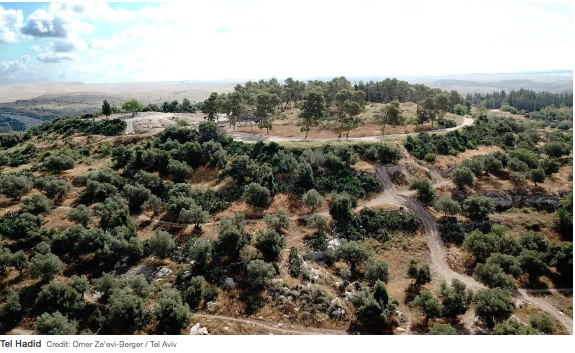
Photos: Published by HaaretzTel Hadid Credit: Omer Ze’evi-Berger / Tel Aviv
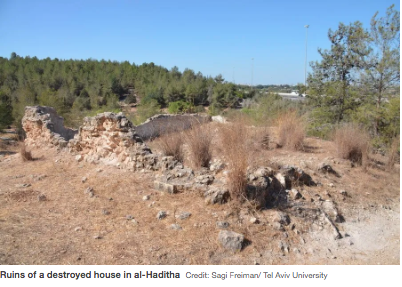
Ruins of a destroyed house in al-Haditha Credit: Sagi Freiman/ Tel Aviv University
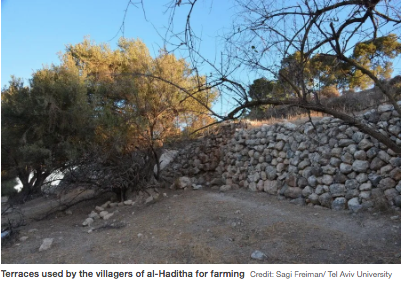
Terraces used by the villagers of al-Haditha for farming Credit: Sagi Freiman/ Tel Aviv University
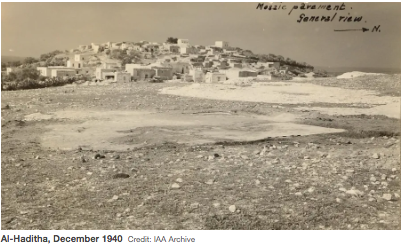
Al-Haditha, December 1940 Credit: IAA Archive
_____
Even as the war in Gaza raged, a group of Israeli researchers forged quiet bonds with Palestinian refugees to bring to light the history of a village depopulated in Israel's 1948 War of Independence
by Ariel David for Haaretz
01:25 PM • December 15 2025 IST
Jamal Eid remembers fondly how, when he was a young man in the 1980s, his father took him to visit their ancestral village of al-Haditha, which his family was forced to abandon during Israel's 1948 War of Independence. Eid, now a 64-year-old bank clerk from el-Bireh in the West Bank, recalls how his father showed him the ruins of their home and their still-standing olive groves in this once bucolic Palestinian community mid-way between Tel Aviv and Jerusalem.
Such heritage visits are not uncommon for those Palestinians who can reach the communities from which their families were uprooted in what they remember as the "Nakba," the "catastrophe" that accompanied the rise of the Jewish State and the first Arab-Israeli war. But more recently the hilltop ruins of al-Haditha have been the focus of an entirely different group of people, a team of archaeologists and historians from Tel Aviv University who have been researching the site to reconstruct the village's history.
The project is a rare endeavor in a country whose mainstream society still struggles to recognize the Israeli role in the suffering and displacement of more than 700,000 Palestinian refugees in 1948. Even more uniquely, the researchers have teamed up with surviving refugees from al-Haditha and their descendants, like Eid, to obtain their permission to excavate their ancestral homes and collect oral testimonies about life in the village and its untimely end.
Starting with (almost) a bang
Like many of the hundreds of Palestinian villages depopulated in 1948, al-Haditha was built atop a tel, an artificial mound formed by superimposed layers of human habitation over thousands of years
Tel Hadid, as it is known in Hebrew, is a major archaeological site in central Israel and one that, until recently, had barely been investigated. In 2018 archaeologists from Tel Aviv University and New Orleans Baptist Theological Seminary set out to change that, and have since uncovered fascinating insights into the site's distant past. Discoveries have ranged from a massive fortress from early Hellenistic times to 2,700-year-old letters testifying to the presence of a mixed community of Israelites and newcomers following the deportations wrought by Assyrian conquerors in the 7th century B.C.E.
But the trigger to investigate the site's more recent past was a much more modest discovery: an unexploded grenade, found in a guard post probably built in the Palestinian village ahead of the 1948 war, says Prof. Ido Koch, the archaeologist who leads the expedition.
Koch then contacted his colleague Yoav Alon, a professor of Middle Eastern History at Tel Aviv, and asked him if he "wanted to do something different," the archaeologist recalls.
This gave birth, in 2022, to the al-Haditha project. Funded by the Israel Science Foundation, it proposes to create a new method to study depopulated Palestinian villages, by combining archaeology, historical research and oral testimonies.
"Israel has always tried to delete these villages from the public consciousness – not just by doing the deed, but, for example, by later planting trees on the ruins as was done in al-Haditha," Alon tells Haaretz by phone. "We go against the grain and try to bring this story to light. We have a role in putting down this story, which is part of the history of the site and of the entire country."
There are many reasons why few Israeli archaeologists have dealt with remains from this period so far. Generally, the use of archaeological tools to investigate the recent past is a relatively new development in the discipline. Specifically for Israel, this is a country that has been obsessed with archaeology since its establishment, and the discipline has often been enlisted for political purposes to highlight the Jewish people's ancient links to the land and justify the rise of the modern state.
So it is no surprise that archaeologists have traditionally preferred to search for remains from biblical times and dig through or around the legacy of the Palestinian displacement, which remains a hugely sensitive and highly politicized topic in Israel.
Historians of different persuasions still acrimoniously debate whether the nascent State of Israel had a purposeful plan to forcibly expel Palestinians or whether most fled amidst the fighting or heeded calls by their own leadership to abandon their homes.
The fact remains that, after the Arabs rejected the November 1947 UN partition of British Mandatory Palestine, civil war broke out between Israel's pre-state Jewish forces and local Palestinian militias, later backed by volunteers and invading armies from neighboring countries. Israel survived and, by the end of the war in 1949, the vast majority of its Arab population (700-750,000 out of the 900,000 who lived within the borders of post-1948 Israel) had been uprooted and were living in refugee camps in neighboring countries, where many of their descendants remain today.
Even though Israeli law doesn't recognize artifacts made after the year 1700 as antiquities, there is growing interest among Israeli archaeologists to scientifically dig the recent past, as evidenced by recent excavations by the Israel Antiquities Authority in Jaffa, Jerusalem and other sites, where modern layers have also been investigated, Koch says.
Still, the al-Haditha dig is only the second archaeological project in Israel to focus specifically on a depopulated Palestinian village. The first, also by a Tel Aviv team, focused on the Upper Galilee village of Qadas, whose inhabitants fled to Lebanon in 1948.
"One of the things I tell my students is that it's still the past, it's the recent past, and we can learn things about people from 70 or 80 years ago just as we learn about those who lived there 2,800 years ago," Koch says.
Moving dirt and moving testimonies
So far, the team conducted only limited excavations in 2023 and last summer, in open areas of al-Haditha, such as courtyards and roads. This is partly due to lack of volunteers during the war in Gaza and because the archaeologists didn't want to dig the destroyed homes of Palestinians without receiving their permission, which they have in the meantime obtained.
One of the goals of the dig is to reach older layers of al-Haditha, as there is a question as to whether the village was established only in the 19th century or, as some court records from Jerusalem indicate, existed already in the 16th and 17th centuries, Koch says.
So far, immediately beneath the village abandoned in 1948, the archaeologists have found a destruction layer from the Iron Age – possibly linked to the Assyrian conquest of the Kingdom of Israel. "We will return there to study the Iron Age in the future, but the origins of al-Haditha will have to be found elsewhere," Koch says. Here and there, artifacts from the lives of the villagers have emerged in the initial probes: mainly 19th century ceramics imported from Europe, porcelain cups, smoking pipes, and cooking pots from Cyprus.
Since they are not considered antiquities under Israeli law, which would make them state property, archaeologists say they will return any artifacts unearthed to the association of Palestinian refugees from al-Haditha once their study is complete. But the project's main achievement so far seems to be the creation of a solid partnership between the researchers and the refugees of al-Haditha, who are mostly spread between el-Bireh, near Ramallah, and Amman in Jordan.
The link was mainly forged by Rami Abu Hamad, a PhD student at Bar-Ilan University researching contemporary Arabic language and literature, especially Palestinian and Jordanian. Abu Hamad conducted dozens of interviews with refugees and their descendants, including with 13 elderly natives of the village.
"Initially there was fear, hesitation, some people were suspicious of our motives," says Abu Hamad, who is from the Galilee and identifies as Arab Israeli. "We slowly built a relationship with them by being fully transparent. I sat with the leaders of the refugee organization, told them about our research and answered their questions."
Gradually, suspicion turned to interest and excitement over a project that promises to deliver a record of lives interrupted by the 1948 exodus.
"I bless any step that can find remains or artifacts that reconnect me to my grandparents or my ancestors," says Jalal al-Atshan, a 64-year-old photographer and the deputy head of the al-Haditha refugee organization in el-Bireh.
The interviews have allowed the researchers to reconstruct the social and economic history of the village, including relations between the different tribes living in al-Haditha, and with the nearest pre-state Jewish community, a youth village in nearby Ben Shemen, Abu Hamad says. The general picture is that internal ties were peaceful, and while there were no major contacts with the Jews there was also no open conflict, he relates.
The witness accounts also focus on the days of the flight from al-Haditha, which occurred in July 1948 after the fall to Israeli forces of the nearby towns of Ramle and Lod and the expulsion of their residents as part of "Operation Dani."
"There were shots and explosions here and there but the abandonment [of al-Haditha] occurred mainly as a result of fear, as they heard of and saw the killing and expulsions from the nearby villages and especially the towns of Lod and Ramle," al-Atshan says.
The roughly 900 residents of al-Haditha initially took refuge in nearby Arab villages, hoping to return after the war. In the following weeks some managed to periodically sneak back to grab some food or treasured possessions, but that soon ended as the former residents realized the village was firmly in Israeli hands.
Gradually they dispersed in several villages, some more friendly and hospitable than others, where they found a temporary shelter. Others moved to Ramallah and its surroundings and settled there. Several families settled in Amman, the capital of Jordan which annexed the West Bank in 1950 and granted the Palestinians under its control Jordanian citizenship, Alon says. The formerly close-knit community was broken and the oral testimonies give a sense of hardship and perhaps also shame as well as loss of and longing to the village, the Israeli historian says.
The eastern part of the village was already demolished in September 1948, he adds. The wholesale destruction of al-Haditha however occurred in February 1967, as part of the broader razing of dozens of depopulated villages across the country. This demolition plan was approved ahead of the end of the military rule that Israel had imposed on its residual Arab population, as authorities feared that, once movement restrictions were gone, some internally displaced Palestinians would attempt to reclaim their lands.
"It's very difficult to reconstruct how the village houses looked in 1948 because the destruction was so massive," Koch says. "There are piles of rubble that are meters high."
Part of their project has been to digitize old aerial photos of the area from before and immediately after the war to recreate a map of al-Haditha and identify the function and owners of each building, he adds.
Stepping on graves
When it comes to Israelis, Koch says he is often called to explain why he is leading such a project.
"People think there is a political agenda, but the answer is that it's part of the history of the site," he says. "We are not trying to prove anything, there is nothing to prove: there was a village, and then there wasn't," he explains. "Its remains are there, and if I ignore them, I fail in my role as a researcher."
Among the descendants of al-Haditha's refugees, there has been growing enthusiasm in the face of the project's preliminary findings, says Eid, the bank clerk from el-Bireh.
"Young people, particularly those in the third generation, have their own lives to deal with and they started to forget about al-Haditha," Eid tells Haaretz in a phone interview translated from Arabic by Abu Hamad. "This project has reawakened the young generation's interest in the village and the desire to learn about its history, its customs and everything connected to it."
Both sides say the October 7, 2023 attacks by Hamas on Israel and the ensuing war in Gaza did not dent the relationship. In a twist of fate, the tides of war even helped the archaeologists a little: In October 2024, during an Iranian missile attack on Israel, a piece of an interceptor missile fell on the tel and sparked a fire, clearing a patch of particularly overgrown cacti and vegetation that concealed a part of the village in a relatively good state of preservation, Koch says.
Serendipitous events aside, the conflict did create logistical difficulties, slowing down the dig and curtailing meetings, but none of the interviewees pulled out or asked not to be identified in an upcoming book about the project, Koch says.
"The blood and family ties between people in the West Bank and Gaza cannot be broken," Eid says. "But we know that in every country and amongst every people there is good and bad, and we know how to distinguish between good people who want peace and those who don't, and I extend my hand to these who do want peace and hope their voices will grow stronger and stronger."
Endeavors like the al-Haditha project help build trust from the ground up and reduce stereotypes that Palestinians have developed about Israelis, Abu Hamad says.
"They see that there are Israelis who can speak to them as equals, recognize the pain they suffered and the loss the war caused them," he says. "This reassures them and maybe allows the two sides to get a bit closer and reduce tensions, at least on a personal level."
Still, the wounds left by the Nakba are far from healed and are easily reopened. As he recalled his own recent visit to al-Haditha with the Israeli researchers, al-Atshan praised the work done by the expedition but lamented the state of the village.
"It pained me when I saw that in the upper cemetery there is a picnic spot where people step on the graves of our grandparents," he says. "It saddened me that they destroyed the village completely, almost flattened it, and didn't leave any house standing, or anything that could connect us to our ancestors."
| Credibility: |  |
 |
0 |
Additional Reports
Palestinian Teen Sentenced to Five Years in Prison
12:00 Sep 27, 2020
Israel's Petah Tikva Detention Center, 0.74 Kms
6 injured, 1 Palestinian teen detained in reported shooting, stabbing attack in Petah Tikva
16:30 Feb 09, 2017
Petah Tikva, 0.79 Kms
Man beaten by crowd of Israelis for shouting warnings in Arabic during shooting
12:00 Feb 09, 2017
Petah Tikva, 0.79 Kms


Leave a Comment