
Palestine Crisis Map
Sept 17, 2015: Israel OK's sniper fire against stones. 2015-2020: ~100,000 more Israeli settlers move to West Bank & Jerusalem. Jan 2022-Sept 2023: ~404 Palestinians, 58 Israelis killed. 10/7/23 to date: ~73,700+ Palestinians, ~1,850 Israelis killedVerified
Palestinian village terrorized by Israeli settlers
21:50 Aug 5 2026 Tuba (ٱلطُّوبَا) and Israeli settlement of Havat Ma’on (מָעוֹן)
Description
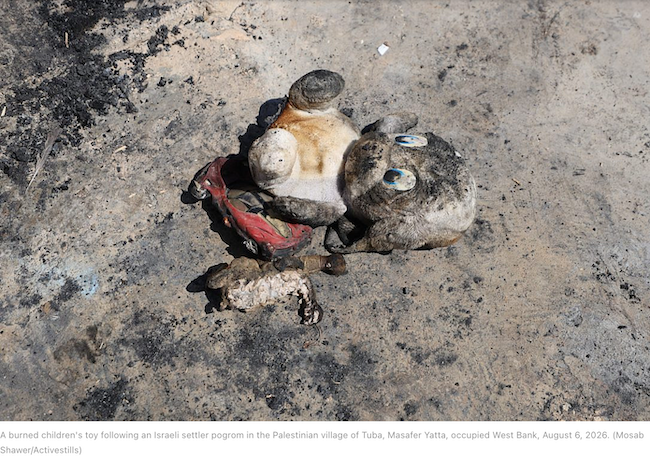
Photos: Published by 972MagA burned children's toy following an Israeli settler pogrom in the Palestinian village of Tuba, Masafer Yatta, occupied West Bank, August 6, 2026. (Mosab Shawer/Activestills)
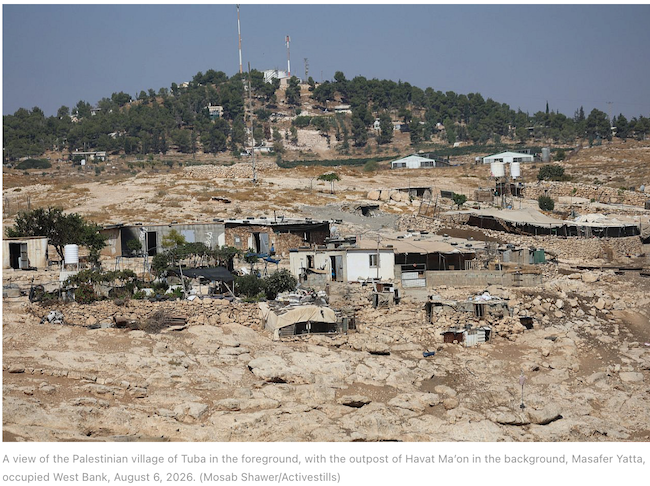
A view of the Palestinian village of Tuba in the foreground, with the outpost of Havat Ma’on in the background, Masafer Yatta, occupied West Bank, August 6, 2026. (Mosab Shawer/Activestills)
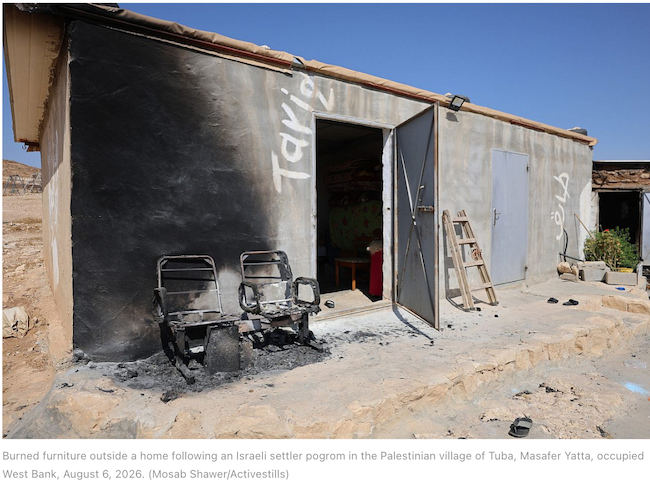
Burned furniture outside a home following an Israeli settler pogrom in the Palestinian village of Tuba, Masafer Yatta, occupied West Bank, August 6, 2026. (Mosab Shawer/Activestills)
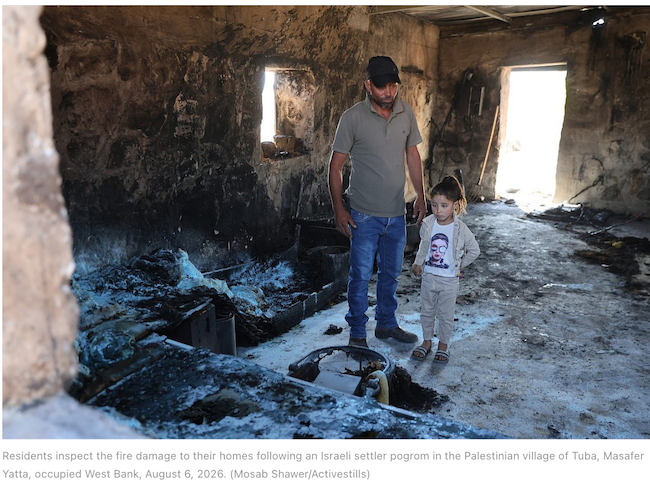
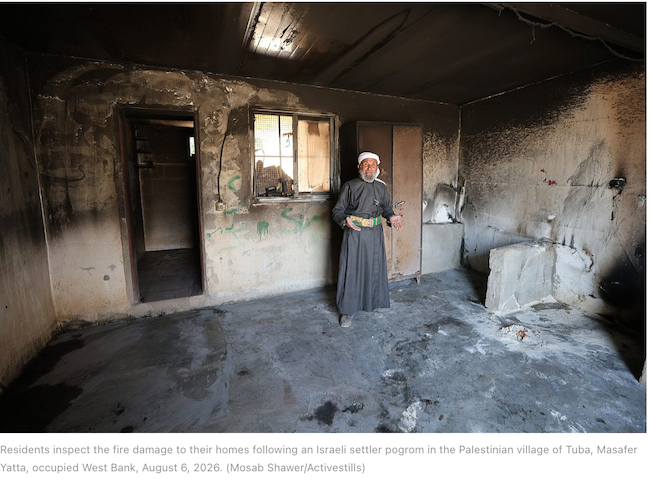
Residents inspect the fire damage to their homes following an Israeli settler pogrom in the Palestinian village of Tuba, Masafer Yatta, occupied West Bank, August 6, 2026. (Mosab Shawer/Activestills)
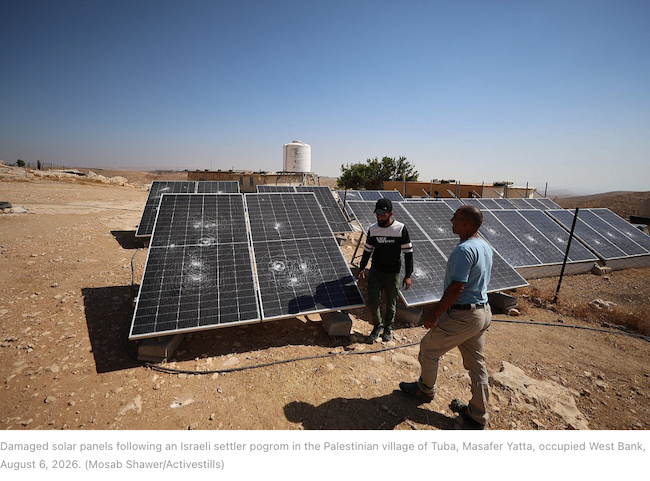
Damaged solar panels following an Israeli settler pogrom in the Palestinian village of Tuba, Masafer Yatta, occupied West Bank, August 6, 2026. (Mosab Shawer/Activestills)
Residents inspect the fire damage to their homes following an Israeli settler pogrom in the Palestinian village of Tuba, Masafer Yatta, occupied West Bank, August 6, 2026. (Mosab Shawer/Activestills)
________
A night-time pogrom by dozens of settlers left residents wounded, houses burned, and solar panels destroyed in the isolated West Bank village of Tuba.
By Basel Adra for 972Mag
August 7, 2026
The WhatsApp message arrived at 9:50 p.m. on Wednesday. It was a desperate plea for help from Hamza Abu Jundiya, a 22-year-old from the village of Tuba in Masafer Yatta: “The settlers are setting the houses on fire.”
At 10:11 p.m., another message: “Send ambulances and firefighters. There are injured children and houses are burning.”
Those few words captured the terror unfolding that night in the small village, located along the southern edge of the occupied West Bank. It has been the target of arson attacks by Israeli settlers before, but this appeared to be on a different scale.
Getting to Tuba is never easy. The dirt road leading to the village has been left damaged and eroded by winter rains because Palestinians are forbidden from repairing it; any such action would be considered “illegal construction” in an area where permits are impossible to come by. In the best-case scenario, the journey takes around 30 minutes.
From my own village of At-Tuwani, it once took only five to 10 minutes. But the establishment of the Havat Ma’on outpost and Ma’on settlement cut off our access to the direct road, leaving Tuba increasingly isolated whenever violence erupts.
For the families trapped inside their homes that night, every passing minute felt endless. Rana Maghnam, 37, was sitting in the guest room with her 7-year-old stepdaughter, Razan, when the attack began.
“I looked through the window and saw a group of settlers running down the hill,” she recounted. “I stepped outside, and the first settler who reached our house came straight toward us. He was carrying a stick and immediately started beating me while the girls hid behind me.
“We ran into another room to protect ourselves, but the settler followed us,” Maghnam continued. “Razan was struck by a stone thrown from outside the house that hit her nose and upper lip. Then the settler caught up with us again and beat me on my head and my arm.”
The assault left Maghnam with fractured fingers in her right hand and a deep head wound that required eight stitches. She was evacuated to a hospital in the nearest city of Yatta, where she received emergency treatment. But long after the wounds had been stitched up, the memories of that night remained impossible to erase.
She still struggles to describe the fear of seeing dozens of Israeli settlers raiding her village. “It was a terrifying night. The sounds of screaming, crying, people being beaten, and windows shattering echoed all around. Flames rose from the [guest] room where we had been sitting, and smoke seeped into the room where we hid after they set fire to the chairs, sofas, and wooden furniture outside the house.”
When daylight finally came, the destruction revealed itself in full: Three homes had been burned beyond recognition. The village’s electricity network was severely damaged by the fires, and the settlers had smashed approximately two-dozen of the village’s solar panels. Five residents, including three children, were wounded.
On their way out of the village, the settlers had spray-painted the words “1:0 for the Jews” in Hebrew on one family’s sheep pen — a message that residents saw not only as vandalism but as a celebration of their suffering.
‘They set the house on fire while I was still inside’
Inside one of the burned homes the following morning, everything had turned black. Melted electrical wires hung from the ceiling. The floor was covered in ash. The refrigerator had become nothing more than a twisted shell of metal. Even 15 hours after the fire, the smell of smoke was so overwhelming it made breathing difficult.
Standing inside the remains of her family’s house, 17-year-old Sujood Mahmoud Awad described what she had witnessed the night before. “I was sitting inside the house when I heard noises outside. I looked up and saw settlers throwing stones at the windows. I ran into the bathroom and hid. I called my father, who was sleeping in the next room.
“My brother, Joud, who is 11 years old, was asleep in his room. A settler grabbed him by the neck, choking him, and threw him outside.
“They came back into the house. I could hear things being destroyed. They threw the refrigerator and the washing machine onto the floor and then set the house on fire while I was still inside, trembling with fear.”
In that moment, she was not sure if she would ever make it out alive. “A settler started hitting the bathroom door. The door slammed into my face and I fell to the floor. When the settlers finally left, thick smoke filled the house. The fire spread rapidly from room to room. I ran outside terrified, but I couldn’t breathe. I collapsed outside the house because of the smoke.”
Her father, Mahmoud Awad, awoke to what he describes as every parent’s worst nightmare. “Our house was burning, along with my brother Mohammad’s house, two hay storage structures, and a tent we used as a storage room. I rushed to find my children. I had three fire extinguishers, but two of them didn’t work. I tried everything to put out the fire, but I couldn’t. We don’t have the firefighting equipment we need.”
He watched helplessly as the village was swallowed by darkness. “The electricity went out, and the village became completely dark. There was only smoke, flames, crying, and screaming. We stood there unable to stop the fire while we watched it consume our homes and destroy everything inside.
“I kept running back and forth carrying water containers, trying to extinguish the flames, but every time I got close, I was choking from the smoke and had to retreat,” he continued. “Nothing was left except stone and twisted metal.”
Everything the family owned disappeared within minutes. “The food, the furniture, the mattresses, the blankets — everything vanished.”
‘They smashed security cameras, floodlights, and our bathroom’
Hamza, whose message that night had first alerted me to the attack, said that after the settlers set fire to his cousin Radwan’s house, they moved toward his family’s home.
“One of the settlers was carrying two bottles filled with flammable liquid. My mother, my sisters, and the children ran inside the house and hid. My father, my brother, and I stayed outside to defend our home. We managed to stop them from setting it on fire, but they hit me with stones in my hand and back.
“They smashed three security cameras, the floodlights around the house, and our outdoor bathroom,” he continued. “They also shattered the windows trying to break into the house. My mother was struck in the face by shards of broken glass.”
As more residents from the village gathered and rushed toward the house to help defend it, the settlers eventually retreated toward the nearby Havat Ma’on outpost, located only a few minutes from Tuba. It is the same outpost from which dozens of settlers recently attacked my own village of At-Tuwani: setting fire to the mosque as well as houses and cars, smashing windows, and spray-painting “Revenge.”
Young men and volunteers from neighboring villages rushed to help extinguish the fires before emergency crews could arrive; because of the condition of the road, ambulances did not reach Tuba until nearly an hour after the attack had started. Thick smoke covered the village while residents moved through the darkness carrying handheld flashlights, searching for survivors, helping the injured, and trying desperately to save whatever remained.
Israeli police arrived approximately 40 minutes after the attack started, approaching from the direction of Havat Ma’on. Israeli soldiers, who are responsible for security in this part of the West Bank, did not arrive until more than an hour after the assault had begun.
Residents say the police moved from one burned building to another taking photographs and recording videos — routine procedures that, in their experience, rarely lead to the prosecution of the attackers. Meanwhile, soldiers were openly hostile toward the villagers. They threatened residents with arrest, and walked through the burned homes with their weapons pointed at civilians.
If the police were genuinely interested in identifying those responsible, they would know exactly where to look. The settlers came from the nearby outpost and settlement — places equipped with some of the most advanced surveillance cameras in the area. But residents are not hopeful that their attackers will be brought to justice; instead, they are left to prepare for the next pogrom.
On Friday afternoon, three settlers from Havat Ma’on were already back in the village harassing residents.
Features
Israeli settlers burn home, beat villagers 8/5/2026
Settlers from Havat Ma'on reported burning home, beating villagers of at-Tuba 8/5/2026
| Credibility: |  |
 |
0 |
Additional Reports
What I would’ve told the Knesset about settler violence — if they’d let me
00:00 Oct 15, 2021
At-Tuba (الطوبا) and Israeli settlement of Havat Ma'on (מָעוֹן), 0.05 Kms
‘Who hits a 64-year-old woman with a bat?’
12:00 Mar 07, 2023
at-Tuba and Israel's Havat Ma'on (מָעוֹן) settlement, 0.07 Kms
[Masafer Yatta: Settlers Vandalize Palestinian Property & Slaughter Livestock]
05:00 May 06, 2023
Masafer Yatta (مسافر يطا): Israel's Ma'on (מָעוֹן) farms settlement and Elavid, 0.37 Kms
[VIDEO: "At the request of the illegal “Havat Maon” settlers, Israeli forces detained five Palestinian children, aged 8–12..."]
12:00 Dec 17, 2025
Israel's Havat Maon (מָעוֹן) settlement, 0.6 Kms
Settlers attack 7-year-old girl in south Hebron hills
12:00 Apr 24, 2014
Tuba - At Tuwani road, 0.65 Kms


Leave a Comment