
Palestine Crisis Map
Sept 17, 2015: Israel OK's sniper fire against stones. 2015-2020: ~100,000 more Israeli settlers move to West Bank & Jerusalem. Jan 2022-Sept 2023: ~404 Palestinians, 58 Israelis killed. 10/7/23 to date: ~73,700+ Palestinians, ~1,850 Israelis killedVerified
Israeli Youths ...Deployed to Expel Palestinians in the West Bank
12:00 Jan 9 2026 Occupied Palestinian Territories (oPT): Qabalan (قبلان), Mukhmas (مُخماس), Sde Yonatan & Kol Hamevaser outposts, Deir Dibwan (دير دبوان), al-Farisiyah, Duma (دوما), Ras Ein al-Auja
Population transfer/expulsion Vandalism/Theft Physical assaults Homocide/Manslaughter Summary Reports

Description
Photos: Published by HaaretzK. urinating at Bedouin structures at Mukhmas in July.An Israeli youth in the residential area of a Palestinian community in the West Bank. Credit: Oded Paporish and Torat Tzedek/Herd of Justice
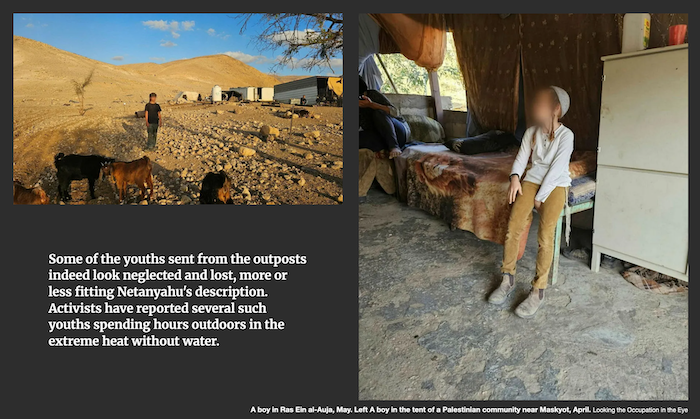
A boy in Ras Ein al-Auja, May. A boy in the tent of a Palestinian community near Maskyot, April. Credit: Looking the Occupation in the Eye
_____
'A Handful of Kids?' An Army of Israeli Youths Is Being Deployed to Expel Palestinians in the West Bank
Some come from normal homes, others are at-risk, some aren't even teenagers yet – this 'handful' that Netanyahu talks about. They're sent to terrorize Palestinian villages, their violence is well documented, and Israel's welfare authorities are powerless
by Amira Hass and Matan Golan for Haaretz
Jan 9, 2026
One teenager kicked Yotam, an Israeli leftist activist, in the crotch. A younger teen kicked Yotam's friend. The two boys were armed with clubs and knives and had a goat herd with them. It was Saturday morning June 21, and they had just trespassed at the living compound of Bedouin of the Ka'abneh clan on the outskirts of Mukhmas, southeast of Ramallah in the West Bank.
The Israeli authorities know the name of the younger teenager, whom I'll call K. He's originally from one of the older settlements in the Mateh Binyamin Regional Council in the West Bank.
K. has been spending a lot of time at the illegal Sde Yonatan settler outpost, which was established on privately owned land at the village of Deir Dibwan. K. has also been spotted at a newer outpost, Kol Hamevaser. The Israeli Civil Administration in the West Bank keeps demolishing these two outposts and the settlers keep rebuilding them.
On June 28, K. and another youngster were seen driving an all-terrain vehicle as they trespassed at the compound, broke a fence, drove between the houses and sat down in a yard as if they owned the place.
Yotam has been documenting harassment at Mukhmas in an attempt to stop it, in what is called "protective presence" activity. He and another activist, Yoram Sorek, reported K. to the welfare authorities and were told that the complaint was being thoroughly reviewed by the relevant people. Four days after receiving this response, on a cold and rainy December 15, K. was spotted alone leading a herd on an asphalt road in the village of Deir Dibwan.
Between June and December, K. was spotted several times in the Bedouin community in Mukhmas; once he arrived by tractor at 1 A.M., plowed privately owned land and broke a pipe in the process. He was also seen herding goats between the houses, trying to empty a water tank, feeding his goats stolen feed, and trying to break into houses. Sometimes he was accompanied by another youngster. He was once filmed urinating between houses, and once he was playing loud music nearby.
Every week, dozens of minors like K. are filmed while staying at illegal settler outposts in the West Bank. They set out from them on their way to commit acts of vandalism and harassment. The phenomenon is so well known that, answering a question from Fox News last week about settler violence, Prime Minister Benjamin Netanyahu blamed "a handful of kids."
The members of this handful share remarkably similar behavior patterns; they seem to have been taught in special classes. They herd goats even in places and during seasons where there is hardly a blade of grass, and they herd the animals straight into the living areas of Palestinian shepherd communities.
They harass elderly people, including women. They try to empty tanks of water brought to the community by tractors and tankers, and to vandalize pipes and solar panels. Sometimes they come alone, sometimes in big groups.
Sometimes they're accompanied by an adult or two, at least one of whom is armed. They threaten and curse. They come so near residents and their guests that they're almost touching, and the former have to show great restraint so as not to push them away.
Division of labor
These young people go into Palestinian communities both during the day and at night. One night in October, 10 of them entered the Jordan Valley community of al-Farisiyah. Armed with knives, they roamed between the structures and shined their flashlights into windows. They imitated dog barks and wolf howls, blew a shofar and yelled "Elul," as is the custom of Jews on their way to say the Selichot penitential prayers.
On October 6, around a dozen young people – most under 18 – trespassed on a Zawahreh and Ka'abneh Bedouin community in the village of Duma southeast of Nablus. The trespassers emptied a water tank, broke windows and a fence, and stole a phone. One kicked a puppy while others beat two activists doing protective presence work: a young man and a 60-year-old woman.
On Sunday last week, another minor whose full name is known to the authorities punched activist Daniel DeMalach in the face near the Palestinian community of Ras Ein al-Auja. The teenagers – who sometimes appear to be under 16 – have also driven all-terrain vehicles down unpaved roads straight into Palestinian tents and shacks. On Saturdays, the trespassers are always more numerous.
Netanyahu said that this "handful of kids" consists of "70 kids. They're not from the West Bank, they're actually teenagers who come from broken homes." There are two inaccuracies in this remark, and two errors. The errors are about the number and age of the people committing the violence: It's not just kids; many adults take part in the attacks that are well documented in videos and countless testimonials.
The results are unequivocal: Over 70 Palestinian shepherd communities in the West Bank were forcibly displaced from their living compounds and expelled between 2022 and late November 2024, according to the rights groups Kerem Navot and B'Tselem. According to the UN Office for the Coordination of Humanitarian Affairs, this amounts to 700 families, with 3,900 people forcibly displaced.
At the same time, Israeli goat farms have taken over between 700,000 and 800,000 dunams (198,000 acres) in the West Bank, dominating it, according to Kerem Navot and the Israeli farm association in the West Bank. In this way Palestinian access – for both shepherds and farmers – to land on which they and their families have been herding, planting and harvesting for generations has been blocked almost entirely.
A WhatsApp account of a right-wing settler group boasted that during the span of a month late in the fall, the "fight against the Arab enemy" included attacks on 40 villages and 12 houses, the burning of 54 vehicles, the wounding of "15 Arabs," the cutting down of hundreds of olive trees, the breaking of hundreds of windows and the setting on fire of one mosque and dozens of fields and orchards. Seventy kids, or even 70 kids and adults – energetic and backed by the army as they might have been – would never have been able to carry all this out on their own.
As of November, 360 outposts have been counted, of which 140 have been set up since the beginning of the war. A full 120 of the outposts are private farms that can't handle their livestock without this army of young people.
Three of these young people on every farm are enough for their number to be significantly higher than the figure mentioned by Netanyahu. Indeed, Amana Nissim of the farm association, which was established in 2024, said in September at a conference celebrating the 50th anniversary of the Gush Emunim settler movement that farms "are established with lots of youths … who have been tripling settlement in Judea and Samaria" – the West Bank.
In an interview with the Chabad website, farm owner Shabtai Koshlevsky and a member of Hashomer Yosh, an organization that parcels out volunteers among the illegal farms, said that shepherding allows domination over a larger area. But actually, it's not the shepherding that facilitates domination but the violence by Israeli teenage and adult shepherds and their use of goat herds as a weapon against Palestinian communities and their flocks.
Protective presence activists have gotten the impression that there is a clear division of labor between minors and adults: The Israeli teenagers are sent to tire out communities day after day, week after week. At the right moment, armed adults arrive in a large group and make clear to the exhausted, terrorized Palestinian shepherds – with much more direct and violent attacks – that they must leave. "These are child soldiers in every respect," says an activist named Sharon, who actually comes from a religious-Zionist family.
Netanyahu's two inaccuracies are about the violent kids' addresses and the worn-out stigma regarding their family background ("from broken homes"). Indeed, the welfare and education authorities have long been aware of the phenomenon of violent teenagers skipping school and spending time in the West Bank.
Already on January 5, 2016, the Knesset Education, Culture and Sports Committee debated this issue. In the shadow of the murder of members of the Dawabsheh family in Duma, committee chairman Yaakov Margi of the ultra-Orthodox Shas party said that the dangerous phenomenon of the "hilltop youth" should be treated "as one would a ticking bomb." He said he was sorry that "the treatment of hilltop youths, who are mostly dropouts, has failed."
Despite that session and Margi's determination, more Israeli activists had to accompany more and more Palestinian shepherds who have been systematically pushed off their pasture land by Israeli civilians. In June 2019, activists from the groups Machsom Watch, Ta'ayush and Tag Meir approached the welfare authorities in settlements andJerusalem through attorney Eitay Mack, warning of this phenomenon of at-risk minors.
In November 2021, Naftali Bennett's government resolved to set up an interdepartmental team to "reduce and prevent dropping out from the education system and at-risk situations among Judea and Samaria youths." The Welfare and Social Affairs Ministry soon set up the Mithabrim program, which the ministry told Haaretz is "a designated solution to the deteriorating at-risk condition of youths in farms and on hilltops." That is, in contrast to Netanyahu's reply, these youths have not been characterized as only dropouts from schools in Israel.
A shadow of himself
Protective presence activists, most of them over 40, agree that the youths' condition has worsened as their actions have become more aggressive. Activists fan out daily in the Jordan Valley, in the area east of Ramallah and Masafer Yatta, and stay with Palestinian communities. Some of these locals have had to relocate, while others cling to their land by their fingernails, despite the rising violence against them.
In the last decade and until the war in Gaza, activists would accompany the shepherds. Since the war started, they have seen the settlers' increased daring. Armed and with the help of the army, outpost dwellers don't allow the remaining Palestinian shepherds to take their flocks out to pasture, and the flocks remain locked in sheds.
The activists recognize the armed security coordinators of the settlements, the operators of the sheep farms, the outpost chiefs, the other adults and the teenagers who go with them or by themselves from the outposts to carry out their tasks. In addition to complaints to the police, the activists have warned about the youths' condition in dozens of email reports – seen by Haaretz – and hundreds of phone calls and WhatsApp messages to social workers in settlements and at the Welfare Ministry.
They are guided by the Youth Law, which, in part, defines a youth in need as a minor who has committed a criminal offense and has not stood trial. He or she is living under a bad influence and in a place being used for a criminal offense, and may suffer physical or psychological harm.
Despite all the reports, activists' own findings and the Welfare Ministry's promises, activists have the impression that professional treatment of the phenomenon is far from serious.
Some of the youths sent from the outposts indeed look neglected and lost, more or less fitting Netanyahu's description. Amir Pansky and Gali Hendin, for example, who for five years have accompanied the residents at Ras Ein al-Auja, reported several such youths spending hours outdoors in the extreme heat without water and wearing sandals in an area rife with snakes and scorpions. At first Hendin reported this in person to the Jordan Valley Regional Council; she says she was referred to the Mateh Binyamin Regional Council, as those minors were under its jurisdiction.
Pansky would send the Jordan Valley Regional Council short reports on WhatsApp, sometimes also phoning the council's security switchboard or a social worker. He once reported a child who seemed to be 10 or 11 sitting by himself next to a slide at the al-Auja canal.
Another time, he reported an adolescent – whose full name he knew – who was healthy when he arrived at the outpost and one year later was a shadow of himself. To the best of Pansky's knowledge, the boy had contracted brucellosis, a disease caused by unpasteurized milk products or from contact with the droppings of animals that are sick with the disease. The report was passed on to a local nurse, Pansky was told.
Another time, he reported another youth whose name he knew; the boy was pale, had dark circles around his eyes, and "incessantly and loudly expelled gas from several parts of his body and made retching sounds." Pansky suggested that he see a doctor; in response, the youth beat him.
On August 11, in a phone call with Q., a senior social worker at the regional council, Pansky named a minor who "within one year had transformed from a youngster to a violent offender." Q. responded that the boy didn't live in the Jordan Valley and that she had no way of knowing where he was from. She said she would pass on the report to a district social worker who works according to the Youth Law – the mantra repeated by by all the settlers' social workers. Q. added that, in cases where the parents support their child's actions, any intervention by her would exceed her authority.
Or, in her words: "Once I'm told, 'The parents agree, the parents know, the parents want this,' and we don't see anything – not even on videos – that requires us to do anything based on the Youth Law, then it's out of my hands."
Confirmation of such supportive parents may be found in a mid-December article in the newspaper Besheva telling about the establishment of a "hilltop and farm youths' mothers' forum." The mothers deny claims about settler violence and unwittingly correct Netanyahu's inaccuracies. These children come from normal, not dysfunctional, families in the settlements. The boys, whom the parents view as the successors of King David and of the early days of the settlement movement, are motivated by a love of the land, the parents say.
The parents were probably infuriated by the labeling of their sons as "dropout youths" at a meeting of the Knesset Foreign Affairs and Defense Committee's Subcommittee for Judea and Samaria last March. Several protective presence activists were invited to this meeting, titled "A solution for fringe youths living or staying in Judea and Samaria." The activists believed that the debate would focus on problems raised in their many letters.
So did committee member Ram Ben Barak of Yair Lapid's Yesh Atid party, who initially spoke of 400 or 500 abandoned youths, some of whom, according to Ben Barak, came from the West Bank, while others came from all over Israel. They had made contact with the farms, and "with people who are ideological extremists … and have become violent and petty criminals."
Yossi Maimon of the National Security Council said the number was a few dozen. Ben Barak corrected his statement, saying the number was about 200. The committee's chairwoman, Michal Waldiger of the Religious Zionism party, and a psychologist she invited to the session insisted that the issue was Israeli youths in the West Bank who are in danger and under stress due to the release of Palestinian prisoners.
At the end of the debate, Likud's Avichay Buaron made clear that he was not alarmed. "In the vast majority of cases, these are good boys, idealistic youths who are doing good things," he said. "It's true that there are youths on the fringe, as in every group of youths. ... This needs to be treated. These youths must be strengthened and given all power to continue on their important mission of making wasteland bloom and protecting our land."
With his remarks, he confirmed the activists' conclusion: The commander's spirit at work in expelling Palestinians from West Bank land is what has prevented the authorities and social workers in the settlements from acting professionally and treating these violent at-risk youths.
Yoram Sorek outlined a complaint in this spirit in a letter to the social workers' ethics committee. In reply, the committee said it rejected the attempt to blame the social workers and accuse them of an ethical failure. According to the committee, this allegation "should be brought before relevant government authorities, demanding that the ministries of welfare, education and national security provide clear answers, clarifying their treatment or non-treatment of the issue."
For its part, the Welfare and Social Affairs Ministry said: "Social workers from local authorities act according to laws and regulations while drawing independent professional conclusions, and only rare cases are referred to the ministry headquarters. Claims that information went unreviewed or untreated do not reflect reality. The intensification of risk factors among youths on the farms is part of a larger trend of intensifying risk for youths during wartime. When the identifying details of the boys were provided, this information was immediately passed on to Youth Law social workers."
The Binyamin Regional Council said: "The council acts according to existing government programs, and Youth Law social workers act according to Welfare Ministry instructions and regulations and under its close supervision. Most of these actions cannot be revealed due to the sensitivity of treating minors.
"The council is not an investigating agency and does not presume to replace the Israel Police. Without a boy's identifying details, it is impossible to act. We firmly deplore any fallacious attempt to link the council with any violent phenomena. As is well known, the council and its head will continue condemning all violent incidents against innocents. In addition, council head Yisrael Gantz presented Prime Minister Netanyahu with a detailed and operative plan to treat 'fringe youths on the hilltops.'"
The Jordan Valley Regional Council declined to comment.
____
oPt
Call To Action | Ongoing Forcible Transfer of Ras ’Ein Al ’Auja | 9 January 2026
Format Situation Report
Sources Protection Cluster UNHCR
Posted 9 Jan 2026
Originally published 9 Jan 2026
Ras ’Ein Al ’Auja community in Jericho governorate of the occupied West Bank is being forcibly displaced, with at least 20 families including 59 children already displaced. A pastoralist Bedouin and herding community, the approximately 100 families of Ras ’Ein Al ’Auja are seen as the longstanding guardians of the al Auja spring and land that forms the gateway to the northern Jordan Valley. The community is home to different social groups, living in separate neighborhoods, and includes a number of families recently forcibly displaced from the nearby communities of Mu’arrajat and Mughayir al Dir. Its expulsion has been a long-term goal of settlers’ intent on Palestinian erasure from Area C of the occupied West Bank.
In the first week of 2026, settlers began erecting new illegal outposts adjacent to residents’ homes, cutting these residents off from other families and intimidating the community. This same predatory practice was used by settlers to previously displace the community of Mu’arrajat, while Israeli military and police present did nothing to prevent it. Ras ’Ein Al ’Auja residents now face daily harassment by settlers, including through settler livestock grazing in residential areas, damage to electricity and water infrastructure, theft of livelihood assets, and threats to their physical safety and freedom of movement, with reports of a woman and a family physically attacked and multiple members detained and reportedly ill-treated. Community members further reported gender-based violence by settlers including harassment, and family separation and psychosocial distress. The rapid intensification of the coercive environment has caused the displacement of at least 20 households. Those that remain have barricaded themselves into their homes in fear of attack.
This forced displacement is currently ongoing, and urgent action is needed to stop the displacement of the remaining families and allow the safe return of those displaced back to their areas of residence. Multiple nearby herding and Bedouin communities have already been forcibly displaced under similar pressures, demonstrating a pattern of forcible transfer that now threatens Ras ’Ein Al ’Auja. The Protection Cluster is continuing to coordinate with partners to provide emergency protection services and calls for immediate action by Member States.
Member States are called upon to urgently:
Join protection partners and provide immediate international diplomatic presence on the ground in the community to support the remaining families, deter attacks, provide visibility, and reduce the threat of their forced displacement.
Engage in private advocacy to stop the risk of forcible transfer of the Ras ’Ein Al ’Auja community.
Rapidly increase financial support to partners to enable scale-up of both proactive and remedial protection in Ras ’Ein Al ’Auja and other communities at high risk of forcible transfer.
Advocate for the unimpeded and safe access for all humanitarian actors and protection partners to deliver essential and lifesaving services.
News Source Link
https://www.haaretz.com/israel-news/2026-01-09/ty-article-magazine/.premium/an-army-of-israeli-youths-is-being-deployed-to-expel-palestinians-in-the-west-bank/0000019b-98b5-d3de-a5db-9cf7875d0000https://en.wikipedia.org/wiki/Qabalan
https://en.wikipedia.org/wiki/Mukhmas
https://en.wikipedia.org/wiki/Deir_Dibwan
https://www.btselem.org/jordan_valley/al_farisiyah
https://en.wikipedia.org/wiki/Duma,_Nablus
https://www.facebook.com/haaretzcom/posts/ras-ein-al-auja-remains-the-last-palestinian-shepherding-community-in-its-area-o/1148245660671445/
https://x.com/IhabHassane/status/2010833338936766798
Features
Location appearing in report of Israeli youth "deployed to expel Palestinians" 1/9/2025
Location appearing in report of Israeli youth "deployed to expel Palestinians" 1/9/2025
Location appearing in report of Israeli youth "deployed to expel Palestinians" 1/9/2025
Location appearing in report of Israeli youth "deployed to expel Palestinians" 1/9/2025
Location appearing in report of Israeli youth "deployed to expel Palestinians" 1/9/2025
Location appearing in report of Israeli youth "deployed to expel Palestinians" 1/9/2025
| Credibility: |  |
 |
0 |
Additional Reports
Israel Blocks Left-wing Activists From Touring Palestinian Village
12:00 Sep 23, 2023
Ein al-Rashash (Ayn-a-Rashash), 0.94 Kms
Israeli forces detain 10 people across the West Bank
01:30 Dec 20, 2011
Duma, Jenin, and Hebron, 1.53 Kms


Leave a Comment